What Is a Retail or Warehouse Solar System?
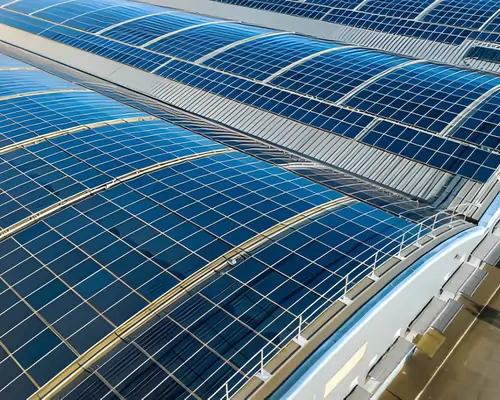
A retail or warehouse solar system uses photovoltaic solar panels to generate electricity for a commercial property.
Depending on the project, solar electricity may power loads such as air conditioning, refrigeration, lighting, office equipment, security systems, computers, warehouse equipment and other electrical services.
The system can generally be designed as:
On-Grid Solar — primarily for daytime electricity-cost reduction.
Hybrid Solar — solar combined with battery storage and grid electricity for selected backup and energy-management requirements.
For warehouses or retail facilities with little or no usable rooftop, other configurations such as ground-mounted systems or solar carports may also be evaluated where suitable.
The correct architecture depends on the property rather than a standard commercial package.
Why Retail Businesses Can Be Good Candidates for Solar
Many retail businesses operate throughout daylight hours.
This can create a useful relationship between:
when solar electricity is generated
and
when the business consumes electricity.
Typical daytime retail loads can include:
Air conditioning, store lighting, refrigeration, chillers, freezers, computers, point-of-sale equipment, CCTV, digital displays, elevators or escalators where applicable, pumps and general commercial equipment.
When solar generation is used directly inside the business, the property purchases less electricity from the grid at that moment.
This is known as solar self-consumption.
For new solar investments in Pakistan in 2026, Grid Solar Installation considers self-consumption one of the most important design priorities.
Why Warehouses Can Be Particularly Suitable for Rooftop Solar
Warehouses often have one physical advantage over many other commercial buildings:
large roof areas.
Research from the U.S. National Renewable Energy Laboratory has identified large roof area and relatively limited rooftop obstructions as important advantages for warehouse solar installations, although it also notes that electricity consumption can vary substantially between different types of warehouses.
This is exactly why warehouse solar requires proper feasibility analysis.
Consider two examples.
A basic dry-storage warehouse may have:
A refrigerated or active logistics warehouse may operate:
-
Refrigeration
-
Air conditioning
-
Compressors
-
Conveyors
-
Sorting equipment
-
IT systems
-
Security systems
-
Forklift charging
-
Offices
-
Loading equipment
Both buildings may have similarly large roofs, but they should not automatically receive the same solar capacity.
Our First Rule for Warehouse Solar: Do Not Size From Roof Area Alone
A common sales approach is:
“Your roof can fit 500 kW, so you should install 500 kW.”
We do not consider that sufficient engineering.
The better questions are:
How much electricity does the facility consume?
When does it consume that electricity?
How much solar can be used directly?
How much generation would become surplus?
What is the sanctioned electrical load?
What are the applicable grid-interconnection conditions?
Is future warehouse expansion planned?
Could battery storage or load shifting make better use of surplus energy?
A large warehouse roof is an opportunity, not automatically the correct solar-system size.
Solar for Retail Stores
Retail solar can be suitable for many business formats.
These can include supermarkets, grocery stores, department stores, showrooms, furniture stores, electronics retailers, pharmacies, fashion stores, shopping outlets, wholesale stores, retail plazas and standalone commercial shops.
Each type of retail property has a different load profile.
For example, a supermarket may have substantial refrigeration loads throughout operating hours.
A clothing showroom may use more electricity for cooling and lighting.
An electronics retailer may have significant air-conditioning, display and equipment loads.
Solar design should reflect those differences.
Solar for Supermarkets and Grocery Stores
Supermarkets can have consistent electricity demand from:
-
Refrigeration
-
Freezers
-
Chillers
-
Air conditioning
-
Lighting
-
POS systems
-
CCTV
-
Computers
-
Signage
-
Storage areas
Because refrigeration and cooling can continue throughout strong solar-generation hours, this type of business may have useful opportunities for direct solar self-consumption.
However, refrigeration is also an operationally important load.
If backup is required during a grid outage, that requirement should be evaluated separately from the solar system's normal bill-reduction function.
Solar for Warehouses and Distribution Centers
Warehouse and distribution facilities can use electricity for considerably more than lighting.
Modern logistics facilities may operate:
-
Conveyors
-
Sorting systems
-
Dock equipment
-
Cooling
-
Ventilation
-
Refrigeration
-
Office areas
-
IT systems
-
CCTV
-
Security
-
Battery charging
-
Packaging equipment
-
Pumps
The U.S. Department of Energy also identifies onsite solar PV as an important energy opportunity for warehouses and distribution centers, while emphasizing that operators should first understand where, why and when energy is consumed.
That principle closely matches our own approach:
Measure the business load before selecting solar capacity.
Cold Storage and Refrigerated Warehouse Solar
Cold storage requires more detailed engineering than a basic storage warehouse.
Electrical loads may include:
-
Compressors
-
Refrigeration systems
-
Condenser equipment
-
Evaporator fans
-
Pumps
-
Control equipment
-
Lighting
-
Office loads
Refrigeration equipment can also involve substantial starting currents and continuous operational requirements.
A solar feasibility assessment should therefore consider:
running load + starting load + operating hours + critical-power requirements.
Solar generation can help serve these loads, but backup during an outage is a separate design problem.
A business should not assume that installing rooftop solar automatically keeps refrigeration running when the utility grid fails.
Retail Solar and Air Conditioning
Air conditioning is often one of the largest electrical loads in a retail property.
This can actually create a useful solar opportunity because cooling requirements tend to increase during sunny daytime periods.
However, AC load needs to be properly measured.
Important factors include:
Running AC from available daytime solar is much easier than providing several hours of AC operation from batteries during a blackout.
If battery-backed cooling is required, inverter and battery capacity can increase significantly.
Pakistan's 2026 Net-Billing Rules Change How Commercial Solar Should Be Designed
Pakistan's traditional 2015 net-metering regulations were repealed when the NEPRA Prosumer Regulations 2026 came into force.
Under the 2026 framework, electricity imported from the distribution company is billed at the applicable tariff, while qualifying electricity exported by the prosumer is credited according to the National Average Energy Purchase Price under a net-billing arrangement.
This matters greatly for retail and warehouse solar.
Grid Solar Installation does not recommend designing a commercial system primarily around the assumption that large amounts of surplus generation should be exported to the grid.
Our preferred order is:
Use solar inside the business first.
Then evaluate how remaining generation should be handled.
This may include grid export where approved, battery storage, load shifting or a more appropriately sized solar array.
Grid Solar Installation's Position on Net Metering for Commercial Properties
Our practical view in 2026 is straightforward:
Traditional net metering is effectively over for new prosumer projects, and new commercial solar systems should not depend on attractive future export compensation to make the investment worthwhile.
The previous 2015 net-metering regulations were formally repealed under the 2026 Prosumer Regulations.
We therefore prefer to design retail and warehouse systems around:
Daytime Self-Consumption + Correct Capacity + Load Management + Battery Storage Where Appropriate
rather than:
Maximum Roof Capacity + Maximum Grid Export.
Grid export can still have a role where permitted.
We simply recommend treating it as a secondary benefit rather than the foundation of the project's economics.
Self-Consumption Is Particularly Important for Retail Businesses
Consider a store producing 50 kW of solar electricity while simultaneously consuming 45 kW.
Most of that generation is being used directly by the business.
Only the remaining generation needs another destination.
Compare that with a warehouse producing 200 kW while consuming only 30 kW.
A large proportion of the solar energy would become surplus.
These systems should not automatically be judged by the same financial model.
In Pakistan's current net-billing environment, understanding the daytime load curve becomes increasingly important.
Retail & Warehouse Solar System Options
On-Grid Solar
An on-grid commercial system may be suitable when the main objective is reducing electricity purchased from the grid.
During daylight:
Solar → Business Load
If demand exceeds solar production:
Solar + Grid → Business Load
Where approved surplus exists:
Remaining Solar → Grid
A conventional grid-tied system normally shuts down during a grid outage for safety.
Hybrid Solar
A hybrid commercial system combines:
Solar + Battery + Grid
This may be useful where the business also requires backup for selected circuits.
For a retail store, priority loads might include POS systems, internet, CCTV, refrigeration controls, selected lighting or other important equipment.
For a warehouse, they might include security, IT, communications, controls, lighting or selected operational loads.
Battery storage should be designed around clearly defined requirements rather than added automatically.
Does a Warehouse Need Batteries?
Not necessarily.
A warehouse with substantial daytime electricity consumption may use solar directly without requiring batteries.
Battery storage becomes more relevant where the facility needs:
However, storage has its own capital cost and technical limitations.
A battery should solve a defined problem.
Does a Retail Store Need Batteries?
Again, not automatically.
If a retail store already has a reliable grid connection and generator or UPS backup, an on-grid solar system may address the main objective of daytime electricity-cost reduction.
A hybrid system becomes more relevant if the business wants solar-integrated backup.
Before recommending storage, we evaluate:
Retail Solar with Existing UPS or Generator
Many businesses already have backup infrastructure.
This might include:
Solar should be integrated with this infrastructure rather than treated as a completely separate installation.
Depending on the system, design considerations may include transfer sequence, generator operation, backup circuits, charging strategy, inverter compatibility and electrical protection.
Grid Solar Installation's 25+ years of electrical installation experience is especially relevant in this type of commercial integration.
Warehouse Solar with Generator Backup
Logistics and storage facilities may already depend on generators during outages.
If solar is added, the project should consider how the generator and solar system will interact.
Generator integration may require analysis of:
-
Generator rating
-
Existing ATS
-
Minimum generator load
-
Reverse-power conditions
-
Solar curtailment
-
Essential circuits
-
Protection
-
Control sequence
These issues should be addressed during system design rather than after equipment has already been purchased.
Rooftop Solar for Warehouses
Commercial warehouse roofs can provide significant installation area, but they still require technical assessment.
A rooftop solar survey should consider roof condition, structural suitability, drainage, wind exposure, skylights, ventilation equipment, fire and maintenance access, shading, future roof repairs, module layout and cable routes.
Commercial rooftop guidance also highlights roof loading and mounting method as important considerations before installation.
The solar array should not create unnecessary difficulty for future roof maintenance.
Solar for Leased Retail and Warehouse Properties
A leased property creates an additional question:
Who has the legal and practical authority to install solar on the building?
Before planning a permanent rooftop installation, the business may need to consider:
-
Lease duration
-
Landlord approval
-
Roof ownership
-
Responsibility for roof maintenance
-
Future tenancy
-
Ownership of the solar equipment
-
Electricity-meter arrangement
Commercial-solar guidance identifies landlord/tenant arrangements and roof ownership as important considerations for solar on leased buildings.
If the customer does not own the property, these issues should be clarified early.
Solar Carports for Retail Properties
Retail sites with parking areas may also evaluate solar carports where technically and commercially suitable.
Solar carports can potentially provide both:
solar-generation area and shade for parked vehicles.
They may be considered where:
-
Rooftop area is limited
-
Parking space is substantial
-
Additional generation is required
-
The site owner wants a purpose-built structure
Carports require their own structural, civil and electrical design and should not simply be treated as ordinary rooftop mounting.
Ground-Mounted Solar for Warehouses
Some warehouse and logistics properties have unused adjacent land.
Ground-mounted solar may offer:
-
Flexible module orientation
-
Easier maintenance access
-
Potential future expansion
-
Reduced dependence on roof condition
But it also introduces considerations such as civil foundations, security, drainage, cable distance, land use and access.
A feasibility study should compare rooftop and ground-mounted options where both are available.
How We Size Retail & Warehouse Solar Systems
Correct commercial solar sizing starts with data.
We evaluate the customer's electricity consumption, working hours and physical site before determining capacity.
The most useful inputs include recent electricity bills, operating hours, major equipment loads, daytime consumption, sanctioned load, transformer information where relevant, generator and UPS systems, usable roof or ground area and planned future expansion.
For warehouses, we pay particular attention to whether the facility actually has enough electrical demand to make productive use of the available roof area.
For retail businesses, we evaluate cooling, refrigeration, lighting and operating-hour loads.
Sanctioned Load Matters
Under Pakistan's 2026 Prosumer Regulations, the proposed distributed-generation capacity under that framework cannot exceed the sanctioned load of the applicant's premises.
This is important for commercial customers.
Having physical space for a large solar plant does not automatically mean the entire roof capacity should—or can—be connected under the applicable prosumer arrangement.
Technical and regulatory feasibility must be considered alongside available roof space.
Larger Commercial Solar Systems Need Additional Engineering
The current Prosumer Regulations define qualifying distributed generation under the framework as renewable generation up to 1 MW.
For proposed distributed-generation facilities of 250 kW or above, the regulations require a load-flow study through the licensee or a reputable consultant registered with the Pakistan Engineering Council.
This can be particularly relevant to large:
-
Warehouses
-
Distribution centers
-
Shopping facilities
-
Wholesale markets
-
Large retail buildings
At this size, grid integration should be treated as an electrical-engineering project rather than merely a paperwork process.
Retail & Warehouse Solar Electrical Safety
Commercial rooftop solar becomes part of the property's electrical infrastructure.
Depending on the system, engineering can include appropriate:
The 2026 NEPRA regulations also require interconnection facilities and metering to meet applicable safety and protection requirements.
Solar should never be treated as only a panel-mounting job.
What Happens During a Grid Outage?
This depends on the system type.
On-Grid System
A conventional grid-tied inverter generally disconnects when grid electricity fails.
This is an important safety function.
Having sunlight available does not automatically mean the store or warehouse remains powered.
Hybrid System
A properly designed hybrid system can support selected isolated loads from battery storage and available solar generation during an outage.
The actual backup depends on:
Before installation, the business should know exactly which circuits will remain operational.
Solar System Price for Retail Stores and Warehouses in Pakistan
There is no responsible single price for retail or warehouse solar.
Project cost depends on factors such as:
Solar capacity, inverter capacity, panel specifications, battery storage if required, roof structure, mounting system, cable distances, electrical protection, existing distribution equipment, grid-integration requirements, generator integration and overall site complexity.
A 100 kW solar installation on one warehouse can have a different engineering scope from a 100 kW installation on another building.
For that reason, Grid Solar Installation recommends a site-specific technical and commercial proposal rather than comparing projects only by price per kW.
How Much Can a Retail Store Save With Solar?
There is no universal percentage.
Savings depend on:
-
Electricity consumption
-
Daytime load
-
Solar generation
-
Electricity tariff
-
Self-consumption
-
Exported electricity
-
Applicable export compensation
-
System cost
-
Battery cost if applicable
-
Seasonal operating conditions
A retail store using most solar generation internally may have very different economics from a property that exports most of its generation.
We prefer calculations that show the assumptions behind expected savings.
How Much Can a Warehouse Save With Solar?
Again, this depends heavily on the type of warehouse.
A cold-storage facility with substantial daytime refrigeration demand has a fundamentally different load profile from a dry-storage warehouse using mostly lighting and security systems.
A large roof does not automatically produce a strong ROI.
The financial analysis should compare:
Solar production vs actual facility consumption.
This is one of the most important principles in warehouse solar design.
Common Retail & Warehouse Solar Mistakes
A common mistake is installing the maximum amount of solar that can physically fit on the roof without studying actual consumption.
Another is assuming that grid export will make every surplus solar unit highly valuable.
Businesses also sometimes ignore roof condition, future roof maintenance, refrigeration starting loads, existing generators, leased-property restrictions or the difference between normal solar operation and outage backup.
Grid Solar Installation's approach is to identify these issues before system capacity is finalised.
Our Retail & Warehouse Solar Installation Process
1. Business Requirement Review
We first determine the purpose of the project:
electricity-cost reduction, backup, self-consumption, business continuity or a combination.
2. Electricity Analysis
We review available electricity bills and operating information.
3. Load Assessment
We examine major electrical loads and when they operate.
4. Site Survey
The available rooftop, parking or ground area and relevant electrical infrastructure are assessed.
5. System Design
We determine an appropriate on-grid or hybrid architecture.
6. Commercial & Technical Proposal
The proposed system should clearly identify its major equipment and project scope.
7. Installation Planning
For an operating retail or warehouse facility, installation should be coordinated to minimise unnecessary disruption.
8. Installation
Solar and associated electrical equipment are installed according to the agreed design.
9. Testing and Commissioning
The completed installation is tested before handover.
10. Handover
The customer should understand system operation, monitoring, shutdown procedures and important operating limitations.
Why Grid Solar Installation?
Our online presence is new.
Our practical experience is not.
Grid Solar Installation brings 10 years of solar installation experience and more than 25 years of electrical installation experience.
Before our recent digital expansion, much of our work developed through relationships with builders, businesses and construction companies.
That background is relevant to commercial solar because retail stores and warehouses are not simply panel-installation sites.
They are functioning commercial properties with existing:
electrical distribution, air conditioning, refrigeration, generators, UPS systems, operational schedules and business-continuity requirements.
Our approach is therefore:
Understand the property first. Design the solar system second.
We do not believe the best solution is automatically the largest system that fits on the roof.
Our 2026 Commercial Solar Philosophy
For new retail and warehouse solar projects, Grid Solar Installation recommends designing around:
Direct Self-Consumption First
Use solar inside your own business whenever possible.
Correct System Sizing
Do not oversize solely because roof space is available.
Smart Load Timing
Where operationally practical, use flexible electrical loads during solar-production hours.
Battery Storage Where It Solves a Real Problem
Consider batteries for backup or energy shifting after analysing the economics.
Grid Export as Secondary
Where approved, export genuine surplus—but do not build the entire investment case around future export incentives.
This approach creates a solar system that depends more on the customer's own electricity use and less on uncertain future policy.
Request a Retail or Warehouse Solar Assessment
If you are considering solar for a shop, supermarket, retail outlet, warehouse, logistics facility or distribution center, useful information includes:
recent electricity bills, business operating hours, property ownership or lease status, major electrical equipment, refrigeration or cooling loads, existing generator or UPS systems, sanctioned load, available roof or land area, backup requirements and expected future expansion.
Grid Solar Installation can use this information to determine whether an On-Grid Solar System, Hybrid Solar System, or another commercial solar configuration is more appropriate for the property.