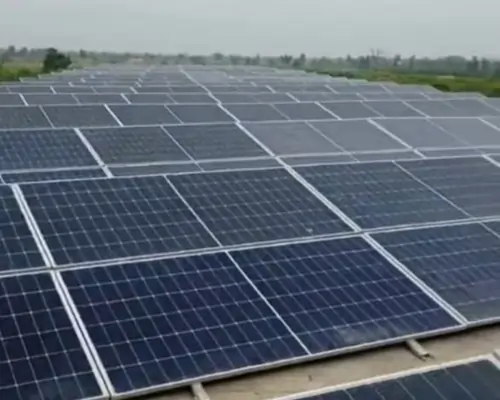
What Is an Industrial Solar Power Plant?
An industrial solar power plant uses photovoltaic solar panels to generate electricity for an industrial facility.
Depending on the project design, solar energy may be used directly inside the facility, stored in batteries, exported to the grid where permitted, or combined with utility and generator power.
A typical industrial solar system may include:
-
Solar PV modules
-
High-capacity solar inverters
-
Rooftop or ground-mounted structures
-
DC cabling
-
AC cabling
-
Combiner and distribution equipment
-
Protection systems
-
Earthing
-
Surge and lightning protection where required
-
Transformer and electrical-system integration
-
Monitoring equipment
-
Grid-interconnection equipment where applicable
-
Optional battery energy storage
-
Optional generator coordination
The correct configuration depends on the facility.
There is no single industrial solar architecture suitable for every factory.
Why Industrial Solar Design Starts With the Factory Load
One of the biggest mistakes in industrial solar is selecting system capacity from the electricity bill alone.
Monthly bills are important, but they do not show the complete electrical behaviour of a factory.
Before determining system size, an industrial project should consider:
-
Monthly kWh consumption
-
Maximum demand
-
Daytime consumption
-
Nighttime consumption
-
Production shifts
-
Weekday and weekend operation
-
Seasonal production changes
-
Transformer capacity
-
Sanctioned electrical load
-
Generator operation
-
Motor loads
-
Starting currents
-
Power factor
-
Planned expansion
-
Available rooftop or ground area
-
Grid-export requirements
Two factories with the same monthly electricity bill can require very different solar systems.
A facility operating most of its machinery from 8 AM to 5 PM may be able to consume a large proportion of solar generation directly.
A facility operating primarily at night has a completely different energy profile.
That is why load profile matters more than package size.
Industrial Solar and Daytime Self-Consumption
Industrial properties can be particularly suitable for solar when electricity demand is high during daylight hours.
Solar electricity generated and consumed immediately inside the factory reduces the amount of electricity that must be purchased from the utility at that moment.
This is called self-consumption.
For example:
Solar generation → Factory load
rather than:
Solar generation → Grid export → Later grid import
This distinction has become increasingly important under Pakistan's current grid-export framework.
A professionally designed industrial system should therefore study how much solar generation the facility can use internally instead of assuming that maximum export provides the best economics.
Pakistan's 2026 Rules Make Industrial Load Analysis More Important
Industrial customers considering a grid-connected solar project should understand that Pakistan's regulatory framework changed in 2026.
Under the NEPRA Prosumer Regulations, 2026, eligible industrial consumers can establish qualifying distributed generation facilities under the applicable interconnection framework.
For these projects, regulatory requirements include considerations such as sanctioned load, interconnection capacity, system size and technical feasibility.
The regulations define a distributed generation facility under the prosumer framework as solar, wind or biogas generation of up to 1 MW.
This distinction matters because larger industrial power projects may fall under a different regulatory and grid-connectivity process.
Grid Solar Installation recommends confirming the regulatory route for each industrial project before finalising the design.
Important: Solar Capacity and Sanctioned Load
Under the current Prosumer Regulations, the proposed distributed-generation capacity under that framework cannot exceed the sanctioned load of the applicant's premises.
For industrial customers, this makes sanctioned load an important part of early feasibility analysis.
Before recommending a grid-connected system, important electrical information can include:
A solar proposal should therefore not be based only on available roof space.
A factory may physically have space for a very large array while the electrical and regulatory conditions support a different configuration.
Load-Flow Study for Larger Industrial Distributed-Generation Projects
Pakistan's current Prosumer Regulations include an important requirement for larger distributed-generation systems.
For a proposed distributed-generation facility with an installed capacity of 250 kW or above, a load-flow study is required under the applicable rules.
The purpose of this type of engineering analysis is to evaluate how the proposed generation interacts with the electrical network.
Depending on the project, engineering assessment may consider factors such as:
For industrial solar, regulatory engineering should be treated as part of the project—not as paperwork added after the system has already been designed.
Industrial Solar Below and Above 1 MW
Industrial customers should be careful with the term “megawatt-scale solar” because the regulatory route can change according to project size and configuration.
Distributed Generation Up to 1 MW
The current NEPRA Prosumer Regulations define qualifying distributed generation under this framework as generation up to 1 MW.
Industrial consumers can fall within this framework subject to the applicable technical and regulatory requirements.
Larger Generation Projects
A project outside the prosumer/distributed-generation framework may require a different regulatory pathway.
Pakistan also has separate Concurrence Regulations 2026 and Technical Standards for Grid Connectivity Regulations 2026 covering relevant generation projects and grid connections.
The exact route should therefore be established from:
We do not recommend presenting every industrial solar project as if the same “net-metering application” applies to all capacities.
Net Billing for Industrial Solar in Pakistan
Pakistan's current prosumer framework uses net billing for qualifying new distributed-generation arrangements.
Under this system:
Electricity imported from the utility is billed according to the applicable consumer tariff.
Electricity exported by the prosumer is credited according to the applicable National Average Energy Purchase Price mechanism.
The two energy flows therefore do not necessarily have the same financial value.
For industrial facilities, this strengthens the importance of designing solar around useful daytime self-consumption.
The goal should not automatically be:
Install the maximum number of panels and export everything that is not used.
A better engineering question is:
How much solar generation can the facility productively consume during operating hours, and what should happen to the remaining generation?
Possible answers may include:
The right solution depends on the industrial load profile.
Industrial Solar for Factories and Manufacturing Facilities
Industrial solar can be considered for many types of facilities, including:
Manufacturing Plants
Production machinery can create substantial daytime electrical demand that may align well with solar-generation hours.
Textile and Garment Facilities
Factories operating machinery, HVAC, compressed air and supporting systems during the day may benefit from a detailed solar feasibility study.
Flour and Food Processing Mills
Motors, processing equipment, ventilation and material-handling loads require proper three-phase and surge-load assessment.
Cold Storage Facilities
Refrigeration and compressor loads require special attention to continuous power requirements and starting characteristics.
Warehouses and Distribution Facilities
Large roof areas may provide useful solar-installation space, while the site's daytime electrical load determines how much generation can be productively consumed.
Pharmaceutical and Processing Facilities
Critical processes and controlled environments require careful separation between energy-saving objectives and backup-power requirements.
Steel, Engineering and Fabrication Facilities
Heavy machinery and motor loads require electrical engineering before inverter and system capacity can be selected.
Packaging and Plastics Facilities
Machine operation schedules and production shifts should be incorporated into the solar design.
Different industries have different load behaviour.
This is why we prefer to engineer around the facility, rather than selling the same solar package to every factory.
Industrial Rooftop Solar Power Plants
Factory roofs can provide substantial space for solar generation without requiring additional land.
However, available roof area alone does not determine whether the roof is suitable.
An industrial rooftop assessment should consider:
Panel layout should also allow the solar system to be safely accessed and maintained.
Before installing a substantial solar array, structural suitability should be appropriately assessed for the specific site.
Ground-Mounted Industrial Solar Plants
Where suitable land is available, a ground-mounted solar system may be considered.
Ground mounting can offer advantages such as:
-
Flexible array orientation
-
Easier cleaning access
-
Easier maintenance access
-
Potential for future expansion
-
Reduced dependence on existing roof condition
However, ground-mounted projects also require additional considerations such as:
The decision between rooftop and ground mounting should be based on total project feasibility rather than aesthetics alone.
Rooftop vs Ground-Mounted Industrial Solar
Rooftop Solar May Be Suitable When:
-
Large usable factory roofs are available
-
Structural conditions are suitable
-
Land is limited
-
Electrical integration points are nearby
-
Roof access can be maintained safely
Ground-Mounted Solar May Be Suitable When:
-
Significant unused land is available
-
Roof construction is unsuitable
-
Easier access is required
-
Optimal array layout is a priority
-
Future expansion is planned
Combined Systems
Some industrial sites may be able to use both rooftop and ground-mounted solar.
The best configuration depends on usable area and electrical design.
On-Grid Industrial Solar Power Plant
An on-grid industrial solar system is typically designed primarily to reduce electricity purchased from the utility while the solar plant operates in parallel with the grid.
During daylight hours:
Solar → Factory Load
If solar generation is insufficient:
Solar + Grid → Factory Load
If approved surplus generation exists:
Factory Load satisfied → Remaining Solar → Grid
This configuration can be attractive for factories with strong daytime loads because a large proportion of the generated energy may be consumed directly.
However, a conventional grid-tied solar plant normally shuts down during a utility outage for safety.
Businesses requiring backup should evaluate hybrid architecture or other properly engineered backup solutions.
Hybrid Industrial Solar System
An industrial hybrid solar system combines solar generation with battery storage and grid electricity.
Depending on the equipment and design, batteries may be used for:
Battery storage at industrial scale requires careful financial and technical analysis.
The cost of storing electricity must be considered separately from the cost of generating solar electricity.
It is not always economical to back up an entire industrial facility with batteries.
In many projects, the better approach is to identify critical loads and design storage around those loads.
Industrial Solar with Generator Integration
Many factories already operate diesel or gas generators.
Solar integration should therefore consider how existing generation equipment operates.
Depending on system architecture, relevant issues may include:
Generator integration should not be improvised after installation.
If a factory depends on generators during outages, this requirement should be included during the initial engineering stage.
Industrial Solar Does Not Automatically Eliminate Maximum Demand
Factories often have electricity costs that include more than energy consumed in kWh.
Depending on the applicable tariff and connection, bills can include demand-related components and other charges.
Solar generation may reduce grid energy consumption during daylight hours, but it should not automatically be assumed that every demand-related charge will disappear.
For example, if a factory reaches its maximum electrical demand at a time when solar generation is low, the solar plant may have little effect on that particular peak.
A realistic financial assessment should distinguish between:
-
Energy charges
-
Demand-related charges
-
Taxes and adjustments
-
Grid imports
-
Export credits
-
Solar self-consumption
We prefer realistic modelling over promising an arbitrary percentage reduction in every industrial electricity bill.
Solar Power Plant Sizing for an Industrial Facility
Industrial solar sizing should use actual operational evidence wherever possible.
Electricity Bills
Several months—and preferably a representative annual history—help show seasonal consumption.
Interval or Load Data
Where available, load data can show when electricity is actually being consumed.
Production Schedule
A factory operating one daytime shift differs considerably from a 24-hour manufacturing facility.
Maximum Demand
Peak demand helps establish the electrical behaviour of the site.
Transformer Capacity
Existing transformer infrastructure can influence system integration.
Sanctioned Load
This is particularly important where the project falls under Pakistan's prosumer framework.
Roof or Land Availability
Physical installation space can create an upper boundary on practical PV capacity.
Future Expansion
New production lines, additional motors or additional shifts should be considered before final system design.
Why kW and kWh Both Matter
Industrial customers should understand the difference between kW and kWh.
kW — Power
Kilowatts measure how much electrical power is being used or generated at a particular moment.
kWh — Energy
Kilowatt-hours measure how much electrical energy is used or generated over time.
A factory may have a high instantaneous load but relatively limited operating hours.
Another facility may have a lower maximum load but operate continuously.
Their solar requirements will be different.
Good industrial solar design needs both types of information.
Industrial Solar Inverter Design
Industrial projects may require multiple inverters rather than one large device.
The final inverter architecture should consider:
-
PV capacity
-
Electrical voltage
-
Phase configuration
-
MPPT design
-
Array orientation
-
Shading zones
-
Grid requirements
-
Maintenance strategy
-
Redundancy
-
Cable distances
-
Future expansion
A modular architecture may make operational maintenance easier in certain projects because a single inverter fault does not necessarily remove the entire plant from service.
The correct arrangement depends on the site.
Transformer and HT/LT Integration
Industrial facilities can have more complex electrical infrastructure than residential properties.
A solar plant may need to integrate with:
-
Main LV panels
-
HT systems
-
Transformers
-
Busbars
-
Distribution boards
-
Generator systems
-
Existing protection
-
Metering systems
The connection point should be selected through proper electrical analysis.
Industrial solar is therefore not only a panel-installation project.
It is an electrical-generation integration project.
This is where Grid Solar Installation's 25+ years of electrical installation experience is particularly relevant to our solar work.
Motors, Compressors and Inductive Loads
Industrial plants commonly operate equipment such as:
-
Pumps
-
Compressors
-
Chillers
-
Conveyors
-
Fans
-
CNC machinery
-
Refrigeration equipment
-
Production motors
These loads can behave differently from simple lighting loads.
Important considerations can include:
Solar capacity should therefore not be selected simply by adding the wattage printed on individual machines.
The complete electrical system should be considered.
Industrial Solar Safety and Protection
Industrial solar plants can involve high DC voltages, substantial current levels and integration with complex electrical infrastructure.
Safety and protection should be treated as core engineering requirements.
Depending on project design, relevant provisions may include:
Pakistan's current prosumer regulations also place requirements on interconnection protection and safe operation.
Electrical protection should never be reduced merely to lower the project quotation.
Anti-Islanding and Grid Safety
When a grid-connected solar plant operates in parallel with the utility, it must not continue energising the public distribution system improperly when the grid supply is unavailable.
This safety requirement is associated with anti-islanding protection.
The solar equipment and protection system should detect abnormal grid conditions and disconnect according to the applicable requirements.
This protects:
-
Utility personnel
-
Factory equipment
-
Solar equipment
-
The electrical network
A grid-connected industrial system should therefore be designed around approved electrical protection—not only energy production.
Solar Monitoring for Industrial Plants
Monitoring is particularly valuable at industrial scale.
Depending on the selected equipment, useful information can include:
-
Instantaneous power
-
Daily solar generation
-
Monthly generation
-
Inverter status
-
String performance
-
Grid import
-
Grid export
-
Plant availability
-
Fault alarms
-
Historical performance
Monitoring helps answer an important business question:
Is the solar plant producing what it should?
For larger systems, performance should be evaluated against weather, operating conditions and expected generation—not simply by looking at the electricity bill.
Maintenance of Industrial Solar Power Plants
Industrial solar is relatively low-maintenance, but it is not maintenance-free.
A maintenance programme can include:
-
Module cleaning
-
Visual inspections
-
Mounting inspection
-
Cable inspection
-
Connector inspection
-
Inverter checks
-
Protection inspection
-
Earthing inspection
-
Thermographic inspection where appropriate
-
Monitoring review
-
Fault-log analysis
-
Vegetation control for ground-mounted plants
-
Generation-performance review
The appropriate maintenance interval depends on the site environment and equipment.
Dust, industrial emissions and local environmental conditions can affect cleaning requirements.
Industrial Solar Financial Feasibility
An industrial solar investment should be evaluated from site-specific data.
Important inputs can include:
-
Project capital cost
-
Annual solar generation
-
Self-consumption percentage
-
Grid-export percentage
-
Applicable electricity tariff
-
Export-credit mechanism
-
Maintenance cost
-
Equipment replacement assumptions
-
Production schedule
-
Expected degradation
-
Financing cost if applicable
-
Future electricity consumption
We do not recommend publishing a universal claim such as:
“Every industrial solar system pays back in two years.”
Actual payback depends on the project.
A credible feasibility study should show the assumptions behind the calculation.
What Should an Industrial Solar Proposal Include?
When comparing industrial solar companies, do not compare only the total price.
A professional proposal should make important assumptions visible.
Look for information such as:
-
Proposed solar capacity
-
Number and rating of modules
-
Inverter architecture
-
Expected annual generation
-
Expected self-consumption
-
Export assumptions
-
Mounting type
-
Electrical connection point
-
Protection scope
-
Transformer-related scope
-
Cable scope
-
Monitoring
-
Civil works
-
Grid-interconnection scope
-
Installation exclusions
-
Project timeline
-
Equipment warranties
-
Workmanship terms
-
Maintenance scope
Two quotations for the same “500 kW solar system” may represent very different engineering and equipment scopes.
Our Industrial Solar Project Approach
Step 1 — Initial Energy Discussion
We first understand the facility's goals.
These may include:
-
Reducing purchased electricity
-
Improving energy-cost predictability
-
Supporting daytime production
-
Reducing generator dependence
-
Adding backup to selected loads
-
Expanding renewable-energy use
Step 2 — Electricity and Load Review
We review available energy information such as:
-
Electricity bills
-
Sanctioned load
-
Maximum demand
-
Operating hours
-
Shift patterns
-
Major machinery
-
Transformer information
-
Generator operation
Step 3 — Site Survey
The physical site is assessed for:
-
Roof availability
-
Ground availability
-
Shading
-
Electrical rooms
-
Transformer location
-
Distribution panels
-
Inverter locations
-
Cable routes
-
Access
-
Installation constraints
Step 4 — Technical Feasibility
The proposed system is evaluated against:
For projects where a formal load-flow study or other regulatory engineering is required, this should be incorporated into the project pathway.
Step 5 — System Design
The system is then designed around the approved project objective.
Design may include:
-
PV capacity
-
Module layout
-
Inverter architecture
-
AC design
-
DC design
-
Cable sizing
-
Protection
-
Earthing
-
Monitoring
-
Integration point
Step 6 — Project Proposal
The customer receives a defined technical and commercial scope rather than only a system-size headline.
Step 7 — Installation Planning
Industrial installation should be coordinated with factory operations.
Where necessary, electrical shutdowns and connection work should be planned to reduce unnecessary disruption to production.
Step 8 — Installation
Solar modules, structures, inverters, electrical equipment and monitoring systems are installed according to the agreed project design.
Step 9 — Testing and Commissioning
Before final handover, the system should be appropriately tested and commissioned.
This may include checking:
-
Electrical connections
-
Protection
-
Inverter operation
-
Monitoring
-
Grid interaction
-
System generation
-
Isolation
-
Relevant operating modes
Step 10 — Handover and Monitoring
The facility team should understand:
Documentation should be retained for future operation and maintenance.
Why Grid Solar Installation for Industrial Solar?
Our digital footprint is recent.
Our practical experience is not.
Grid Solar Installation has 10 years of solar installation experience and more than 25 years of electrical installation experience.
Before developing our current digital presence, our work was built largely through professional networks involving builders, businesses and construction companies.
Industrial solar particularly benefits from this electrical background because a large solar plant must integrate safely with the electrical infrastructure already operating inside the facility.
We do not believe industrial customers should select solar only from an advertised package.
Our approach is to understand the electrical load, infrastructure and operational objective first and then determine the appropriate system design.
As our digital portfolio develops, our goal is to support this experience with documented project information, technical case studies and genuine customer feedback rather than relying only on promotional claims.
Request an Industrial Solar Feasibility Assessment
If your factory or industrial facility is considering solar, prepare the following information where available:
-
Facility location
-
Industry type
-
Recent electricity bills
-
Sanctioned load
-
Maximum-demand information
-
Transformer rating
-
Supply voltage
-
Operating shifts
-
Major machinery
-
Generator capacity
-
Available rooftop area
-
Available ground area
-
Existing solar equipment
-
Future expansion plans
-
Whether grid export is required
-
Whether battery backup is required
This allows a more meaningful discussion than simply asking:
“What is the price of a 500 kW solar plant?”
Contact Grid Solar Installation for an industrial solar assessment based on your facility's real electrical and operational requirements.