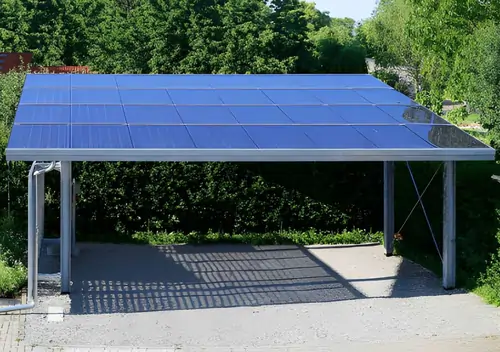
What Is a Solar Carport?
A solar carport is a purpose-built parking canopy that supports photovoltaic solar panels above parked vehicles.
Instead of using parking space only for vehicles, the same area performs two functions:
Parking Shade + Solar Electricity Generation
A typical system can include:
Foundation → Steel Structure → Solar Panels → Inverter → Building Electrical System
Depending on the project, solar electricity may be consumed directly by the property, stored in batteries or exported to the grid where applicable and approved.
The U.S. Department of Energy identifies solar carports and parking shade structures as one of the most common dual-use applications of photovoltaic technology.
What Is a Ground-Mounted Solar System?
A ground-mounted solar system is a PV array installed on a dedicated structure anchored into the ground.
Unlike rooftop solar, the panel layout does not have to follow the shape or orientation of an existing building roof.
This can give the designer greater flexibility when determining:
-
Array orientation
-
Tilt
-
Row spacing
-
System capacity
-
Maintenance access
-
Future expansion
Ground-mounted solar may be appropriate for:
-
Factories
-
Warehouses
-
Farms
-
Commercial properties
-
Institutional campuses
-
Agricultural facilities
-
Large homes
-
Remote properties
-
Open industrial land
The final design depends on land availability and electrical requirements.
Solar Carport vs Ground-Mounted Solar
Both use land rather than conventional roof space, but they solve different problems.
Solar Carport
A solar carport is usually installed above an existing or planned parking area.
It provides:
Solar Generation + Vehicle Shade
It may be especially useful where land already has an important parking function.
Ground-Mounted Solar
A ground-mount system normally uses dedicated open land primarily for electricity generation.
It may provide:
-
Greater layout flexibility
-
Easier maintenance access
-
Easier expansion
-
Flexible panel orientation
The right solution depends on how the property uses its available space.
When Should You Consider a Solar Carport?
A solar carport can be worth evaluating when a property has:
-
Large parking areas
-
Limited usable roof space
-
A roof unsuitable for substantial solar installation
-
A desire to provide shaded parking
-
High daytime electricity consumption
-
Commercial or institutional parking
-
Potential future EV-charging requirements
Possible applications include:
A DOE case study of a large commercial installation highlights the dual benefit of generating electricity while providing shade and weather protection for vehicles.
When Should You Consider Ground-Mounted Solar?
Ground mounting may be appropriate where:
-
Significant open land is available
-
Roof orientation is poor
-
Roof structure is unsuitable
-
Roof area is insufficient
-
Roof access needs to remain clear
-
A larger solar plant is required
-
Expansion may be required later
-
Easier cleaning and maintenance access is preferred
A ground mount should not automatically be selected simply because land is available.
The electrical load and financial objective still determine how much solar capacity makes sense.
Roof Space vs Parking Space vs Open Land
Before choosing the mounting method, Grid Solar Installation recommends comparing all practical options.
Rooftop Solar
Can be useful when the building has:
Solar Carport
Can make sense where:
Ground Mount
Can make sense where:
Some large properties may use more than one approach.
For example:
Rooftop Solar + Solar Carport
or:
Rooftop Solar + Ground Mount
The correct combination should follow the site's electricity requirement and available space.
Why Solar Carports Require Structural Engineering
A solar carport is more than a standard metal parking shade with panels attached afterward.
The structure must safely support:
DOE solar-development guidance notes that carports can require geotechnical evaluation and specialised concrete and structural-steel work because of the large supporting structures involved.
The structure should therefore be designed as a solar-support structure from the beginning.
Wind Load Matters
Solar carports and ground-mounted arrays are exposed structures.
Wind can create significant:
-
Uplift
-
Pressure
-
Structural movement
-
Foundation loading
The required design depends on factors such as:
-
Location
-
Structure height
-
Panel angle
-
Array dimensions
-
Terrain
-
Exposure
-
Structural configuration
We do not recommend copying the same steel structure from one project to another without considering the actual site.
A structure that works for one location may not automatically be appropriate elsewhere.
Ground Conditions and Foundations
The foundation connects the solar structure to the ground.
Ground-mounted and carport systems may require different foundation approaches depending on engineering conditions.
Possible considerations include:
-
Soil bearing capacity
-
Soil type
-
Groundwater
-
Filled ground
-
Slope
-
Existing pavement
-
Underground services
-
Foundation loads
-
Structural design
For larger projects, geotechnical investigation may be appropriate before finalising the structural design.
DOE guidance particularly notes that solar carport construction may need geotechnical assessment because stable structural supports and underground conditions need to be understood.
Underground Utilities Must Be Checked
Parking areas and commercial land can contain underground:
-
Electrical cables
-
Water pipes
-
Sewerage
-
Drainage
-
Gas lines
-
Communication services
-
Other infrastructure
Foundation drilling or excavation should therefore not begin blindly.
Existing drawings, surveys and site information should be reviewed where available.
This becomes especially important for solar carports because foundations are often installed within existing developed parking areas.
Solar Carport Height and Vehicle Clearance
Vehicle clearance is a major design consideration.
A carport designed for standard passenger cars may not be suitable for:
-
SUVs
-
Vans
-
Ambulances
-
Delivery vehicles
-
Trucks
-
Commercial fleets
The intended users of the parking area should be understood before finalising the structure.
DOE commissioning guidance for solar carports also recommends considering vehicle impact risks and measures such as markings or protective bollards where appropriate.
Column Placement Matters
Poorly positioned columns can make parking difficult.
The structural design should consider:
Solar generation is important.
But a solar carport that makes the parking area difficult to use is not a good design.
Solar Carport Drainage
Solar modules change the way rainwater falls onto a parking area.
Instead of rain falling evenly across the pavement, water may collect along module edges and structure drainage points.
The design may therefore need to consider:
Water should not be unnecessarily directed toward building entrances, electrical equipment or areas where pooling creates operational problems.
Ground-Mounted Solar and Stormwater
Ground-mounted solar also changes how rainfall moves across land.
NREL's PV-SMaRT research identifies several major factors affecting stormwater behaviour around ground-mounted solar arrays, including:
-
Soil compaction
-
Soil depth
-
Ground cover
-
Spacing between arrays
The research also notes that water can infiltrate beneath properly designed elevated PV arrays rather than treating the entire solar site like conventional impermeable pavement.
For larger ground-mounted projects, drainage should therefore be part of the site design rather than addressed only after installation.
Ground Slope and Site Grading
A completely flat site is not always available.
Ground-mount design may need to consider:
-
Existing slope
-
Required grading
-
Soil movement
-
Drainage
-
Foundation levels
-
Panel-row alignment
-
Access roads
Extensive grading increases project complexity and may affect drainage.
Where possible, the solar layout should work intelligently with the existing land rather than unnecessarily reshaping the entire site.
Vegetation Management
Vegetation can become an operational issue beneath and around ground-mounted panels.
Uncontrolled growth can:
At the same time, completely removing useful ground cover can create erosion and drainage problems.
NREL's ground-mount research identifies appropriate vegetative ground cover as an important factor supporting infiltration and controlling site conditions.
The correct vegetation strategy depends on the site.
Row Spacing and Self-Shading
Ground-mounted panels are commonly installed in multiple rows.
If the rows are placed too close together, one row can shade another at certain times of day or during certain seasons.
This can reduce electricity generation.
Row spacing should therefore consider:
-
Panel tilt
-
Solar angle
-
Site latitude
-
Array orientation
-
Ground slope
-
Maintenance access
-
Land availability
Using less spacing can fit more panels into the land.
But fitting more panels is not automatically valuable if those modules experience excessive shading.
Solar Orientation and Tilt
A ground-mounted system can offer more flexibility than many rooftops because the structure can often be oriented intentionally.
However, the objective should not automatically be:
“Use one standard angle for every project.”
The appropriate layout depends on:
For commercial installations, solar-production timing can sometimes be as important as maximum annual kWh.
Fixed-Tilt vs Tracking Ground Mount
Ground-mounted solar can use different structural approaches.
Fixed-Tilt Solar
Modules remain at a fixed orientation.
Potential advantages can include:
Solar Tracking
Some large projects may use tracking structures that change module orientation during the day.
Tracking systems involve different:
-
Structural requirements
-
Motors and controls
-
Land layout
-
Maintenance
-
Capital cost
Tracking is not automatically better.
It should be evaluated according to project scale, energy gain, land, maintenance and economics.
Grid Solar Installation will not claim tracking suitability for a specific project without completing the relevant engineering assessment.
Solar Carports and EV Charging
Solar carports are often associated with electric-vehicle charging because both can use the same parking area.
A future-ready property may want to consider:
However:
Solar panels do not automatically mean an EV charger can operate entirely from instantaneous solar generation.
Charging demand and solar production vary throughout the day.
The electrical system needs to be designed accordingly.
Can a Solar Carport Include Battery Storage?
Yes, where technically appropriate.
A hybrid solar carport installation may combine:
Solar Carport + Hybrid Inverter + Battery + Grid
Battery storage may be evaluated for:
However, batteries should be sized from the load requirement rather than the size of the solar canopy.
The fact that a carport can hold 100 kW of panels does not mean the property needs a particular battery capacity.
Ground-Mounted Off-Grid Solar
Ground mounts can be particularly useful for off-grid properties because open land may allow the PV array to be positioned independently from the building.
Applications can include:
-
Farms
-
Remote homes
-
Agricultural facilities
-
Remote commercial sites
-
Construction operations
An off-grid ground-mounted system still requires careful analysis of:
The mounting method does not replace the need for proper system sizing.
Ground-Mounted On-Grid Solar
A ground-mounted system can also operate as a conventional grid-connected solar plant.
During sunlight hours:
Ground-Mounted Solar → Property Load
When demand exceeds solar generation:
Solar + Grid → Property
Where approved surplus exists:
Surplus Solar → Grid
For new projects in Pakistan, Grid Solar Installation recommends designing primarily around useful self-consumption rather than excessive generation purely for grid export.
Pakistan's 2026 Prosumer Rules
Where a solar carport or ground-mounted system will operate as a grid-connected prosumer system, Pakistan's current regulatory requirements need to be considered.
Under NEPRA's Prosumer Regulations 2026, proposed distributed-generation capacity under that framework cannot exceed the sanctioned load of the applicant's premises.
The same framework requires a load-flow study for proposed distributed-generation facilities of 250 kW or above, conducted through the licensee or an appropriate consultant registered with the Pakistan Engineering Council.
NEPRA's current legal register also shows subsequent amendments to the 2026 Prosumer Regulations, together with separate 2026 Concurrence and Technical Standards for Grid Connectivity regulations.
For this reason, regulatory requirements should be confirmed for the individual project rather than relying on an old net-metering guide.
Do Current Grid Rules Limit Physical Carport Size?
Not necessarily.
This distinction is important.
A parking area may physically be capable of supporting a larger solar array than the amount that makes sense under a particular grid-connected prosumer arrangement.
The project therefore has at least three different sizing questions:
How much solar physically fits?
How much electricity does the property actually need?
How much generation is technically/regulatorily appropriate for the proposed electrical configuration?
These answers may be different.
Our Position on Grid Export
Grid Solar Installation's 2026 design philosophy remains:
Self-Consumption First.
We do not recommend building an unnecessarily large carport or ground-mount system only because substantial land is available and the owner expects attractive grid-export compensation.
Traditional net metering has been replaced for new qualifying prosumers by Pakistan's current prosumer/net-billing framework. NEPRA's legal register confirms the 2026 regulatory framework and its later amendments.
Our preferred order is:
1. Understand the actual electrical load
2. Maximise useful direct solar consumption
3. Evaluate future load
4. Consider battery storage where useful
5. Treat approved grid export as a secondary component
This reduces dependence on uncertain future export economics.
Solar Carports for Offices
Offices can be strong candidates for solar carports because parking and electricity consumption often occur during the same daytime period.
Solar generation may contribute to:
-
Air conditioning
-
Computers
-
Servers
-
Lighting
-
Networking
-
Pumps
-
Other office loads
The canopy simultaneously provides vehicle shade.
Where backup is required, hybrid storage can be assessed separately.
Solar Carports for Shopping and Retail Properties
Retail parking areas may offer substantial solar-generation space.
Possible sites include:
-
Shopping centers
-
Supermarkets
-
Commercial plazas
-
Large stores
-
Showrooms
-
Hotels
A carport layout should preserve:
-
Customer circulation
-
Parking capacity
-
Vehicle movement
-
Pedestrian access
-
Delivery routes
Solar capacity should not compromise the property's primary commercial function.
Solar Carports for Factories
Factories may have large employee and visitor parking areas.
A solar carport can provide additional PV space when:
-
Factory roofs are already occupied
-
Structural roof loading is unsuitable
-
Additional solar capacity is required
-
Parking shade is valuable
Electrical design should still reflect factory demand, transformers, sanctioned load and existing power infrastructure.
Ground Mounts for Industrial Solar
Factories with adjacent open land may evaluate a ground-mounted array.
Large projects can require substantial civil and electrical works.
NREL's utility and commercial ground-mount cost modelling identifies activities including:
This illustrates why large ground-mounted solar should be treated as a full engineering and construction project rather than simply “panels on land.”
Ground-Mounted Agricultural Solar
Agricultural properties may also have space for ground-mounted PV.
Possible uses include:
-
Tube wells
-
Irrigation
-
Dairy farms
-
Poultry farms
-
Cold storage
-
Farm buildings
Installation should consider the movement of:
-
Tractors
-
Harvesting machinery
-
Livestock
-
Irrigation equipment
The structure and cable routes should not unnecessarily interfere with agricultural operations.
Security for Ground-Mounted Solar
Unlike rooftop modules, ground-mounted equipment may be physically easier to reach.
Security considerations can include:
-
Site fencing
-
Controlled access
-
CCTV
-
Lighting
-
Secure inverter areas
-
Protected cabling
-
Equipment identification
The appropriate security strategy depends on the site's location and operational conditions.
Solar Panel Cleaning and Maintenance Access
One advantage of many ground-mounted systems is easier physical access for:
-
Cleaning
-
Inspection
-
Module replacement
-
Cable inspection
-
Vegetation management
However, accessible panels can also increase accidental-contact or security risks.
The array layout should therefore balance:
Service Access + Operational Safety + Security
For solar carports, maintenance access should also be considered during the structural design instead of requiring complicated access equipment for every routine inspection.
DOE guidance specifically recommends designing carport systems so serviceable components remain accessible.
Electrical Cable Routing
Solar carports and ground mounts can place the PV array a considerable distance from the building's electrical connection point.
Long cable routes increase the importance of:
-
Cable sizing
-
Voltage drop
-
Trenching
-
Conduit
-
Mechanical protection
-
Route planning
-
Underground utilities
-
Future access
The cheapest physical location for the panels may not produce the best overall electrical design if it creates extremely long or difficult cable routes.
Inverter Location
The inverter may be located near the array or closer to the property's electrical infrastructure depending on the project architecture.
The design should consider:
For larger projects, there may be multiple inverters distributed across the solar site.
Electrical Protection and Earthing
Carport and ground-mount systems are outdoor electrical-generation installations.
The design should therefore consider suitable:
Metal support structures also need to be considered within the project's appropriate electrical bonding and earthing strategy.
Grid Solar Installation's 25+ years of electrical installation experience is particularly relevant to this part of the work.
Solar Carport and Ground-Mount System Sizing
The system should never be sized from available land alone.
Our design process considers:
The site determines what is physically possible.
The load analysis determines what is actually useful.
Solar Carport & Ground-Mount Price in Pakistan
There is no responsible universal price per kW for these projects.
A ground-mounted or carport solar project can have significant structural and civil costs in addition to normal PV equipment.
Price may depend on:
-
Solar capacity
-
Structural steel
-
Foundation design
-
Soil conditions
-
Carport height
-
Parking layout
-
Excavation
-
Concrete
-
Ground grading
-
Drainage
-
Trenching
-
Cable distance
-
Inverters
-
Electrical protection
-
Grid interconnection
-
Battery storage
-
Site security
-
Installation complexity
Two 100 kW projects can therefore have very different total costs.
A site survey is more useful than a generic package price.
What Should a Solar Carport Proposal Include?
A useful proposal should clearly define:
The customer should know whether the quotation covers only solar equipment or the complete carport structure and associated works.
What Should a Ground-Mount Proposal Include?
For a ground-mounted project, ask about:
Large ground-mounted projects should not be compared only by solar-panel price.
Common Solar Carport Design Mistakes
Treating a Normal Parking Shade as a Solar Structure
The structure should be engineered for the actual PV installation.
Ignoring Vehicle Clearance
Future delivery vehicles or larger vehicles may be unable to use the space.
Poor Column Placement
Columns should not unnecessarily obstruct parking and circulation.
Ignoring Underground Utilities
Foundation work can conflict with existing services.
Forgetting Drainage
Solar canopies concentrate rainwater differently from open parking areas.
Ignoring Maintenance Access
Future servicing should be planned before installation.
Oversizing Only Because Parking Space Is Available
Available structure capacity and useful solar capacity are not the same thing.
Common Ground-Mount Design Mistakes
Installing From Land Area Alone
Available land does not determine economically appropriate solar capacity.
Ignoring Soil Conditions
Foundation requirements depend on actual ground conditions.
Poor Row Spacing
Excessive self-shading can reduce production.
Ignoring Drainage
Stormwater can affect foundations, access and erosion.
Ignoring Vegetation
Growth can affect shading and maintenance.
Long Unplanned Cable Runs
Electrical losses and project cost can increase.
No Security Plan
Ground-level equipment may require greater site protection.
No Expansion Plan
If additional capacity is likely, future access and electrical architecture should be considered.
Our Solar Carport & Ground-Mount Design Process
Step 1 — Understand the Energy Requirement
We first establish how much electricity the property consumes and what the solar system needs to achieve.
Step 2 — Assess Available Space
We examine suitable parking area, open land and existing rooftop options.
Step 3 — Load Analysis
We consider daytime consumption, maximum demand and future electrical requirements.
Step 4 — Site Assessment
Depending on the project, we review:
-
Shading
-
Terrain
-
Parking layout
-
Soil conditions
-
Drainage
-
Electrical connection
-
Cable route
-
Site access
Step 5 — Select the Appropriate Mounting Concept
We determine whether the project is better suited to:
-
Solar carport
-
Ground mount
-
Rooftop
-
A combination
Step 6 — Structural and Civil Design
Appropriate structural and foundation requirements are established for the project.
Step 7 — Electrical System Design
We determine:
Step 8 — Technical & Commercial Proposal
The proposal should clearly define both solar and structural/civil scope.
Step 9 — Installation
Civil, structural and solar-electrical works are coordinated according to the agreed design.
Step 10 — Testing and Commissioning
The completed PV installation is tested before handover.
Step 11 — Customer Handover
The customer should understand:
Why Grid Solar Installation?
Solar carports and ground mounts combine multiple disciplines:
Solar + Electrical + Structural + Civil + Site Planning
Grid Solar Installation brings 10 years of solar installation experience and more than 25 years of electrical installation experience.
Before building our recent online presence, much of our work developed through professional relationships with builders, businesses and construction companies.
This background is particularly relevant to projects involving purpose-built solar structures.
Our philosophy is:
Do not force solar onto a roof if another location produces a better overall project.
We first understand the:
Energy Requirement + Property + Available Space + Electrical System
and then determine whether rooftop, carport or ground-mounted solar is the more appropriate solution.
Request a Solar Carport or Ground-Mount Assessment
If you are considering solar over a parking area or on open land, useful initial information includes:
-
Property location
-
Property type
-
Recent electricity bills
-
Available parking or land area
-
Approximate dimensions
-
Existing roof solar if any
-
Single-phase or three-phase connection
-
Sanctioned load if known
-
Desired solar capacity if already assessed
-
Backup requirements
-
Existing generator or UPS
-
Grid-export requirement
-
Future EV chargers if planned
-
Future business expansion
-
Photographs or site drawings where available
Grid Solar Installation can then assess whether Solar Carport, Ground-Mounted Solar, Rooftop Solar or a combined solution is appropriate.