What Is a Hybrid Solar System?
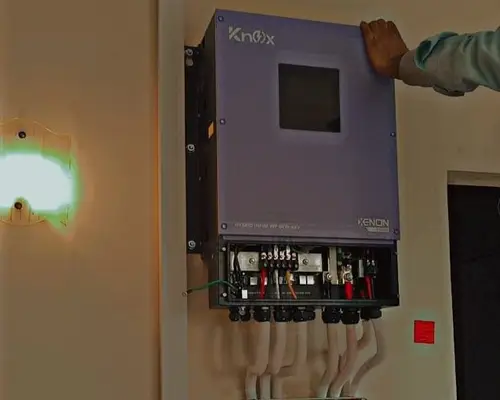
A hybrid solar system normally combines:
Solar Panels + Hybrid Inverter + Battery Storage + Utility Grid
During daylight hours, solar generation can power the property's electrical loads and charge the battery.
When solar production falls, the system can use stored battery energy or grid electricity according to its design and settings.
During a grid outage, compatible hybrid equipment can supply designated backup loads from the battery and available solar energy, provided the system has been designed and wired for backup operation.
Where grid export is approved, eligible surplus solar electricity may also be exported under the applicable regulatory arrangement.
A hybrid system therefore combines some characteristics of an on-grid solar system with the energy-storage capability associated with an off-grid system.
How Does a Hybrid Solar System Work?
The exact operating sequence depends on the inverter, battery configuration, customer priorities and system settings.
A typical system can be configured around the following energy flow.
During the Day
Solar panels generate electricity.
Available solar energy can be used to:
-
Power active household or business loads
-
Charge the battery
-
Export eligible surplus electricity to the grid where grid export has been approved
A well-designed system can prioritise self-consumption rather than unnecessarily importing electricity while usable solar energy is available.
During the Evening and at Night
Solar production reduces and eventually stops.
Depending on the chosen operating strategy, electricity can then come from:
Battery usage does not necessarily need to continue until the battery is completely discharged.
A reserve can be maintained for expected load shedding or emergency backup.
During Load Shedding or a Grid Failure
This is one of the main differences between a conventional grid-tied system and a properly configured hybrid system.
A normal on-grid inverter generally cannot continue supplying the building simply because solar panels are producing electricity when the utility grid fails.
A compatible hybrid system can instead isolate its backup side from the failed utility grid and continue supplying designated backup loads from available solar generation and battery storage.
However, this requires correct system design.
Installing a hybrid inverter does not automatically mean every appliance in the property will continue running during an outage.
Backup capacity depends on:
-
Inverter backup-output capacity
-
Battery power capability
-
Battery energy capacity
-
Electrical wiring
-
Backup distribution design
-
Connected appliance load
-
Motor and compressor surge loads
-
Battery state of charge
This should be decided before installation.
Hybrid Solar in Pakistan Under the 2026 Grid Rules
Pakistan's rules for grid-connected distributed generation changed significantly in 2026.
Under the NEPRA Prosumer Regulations, 2026, electricity imported from the distribution licensee is billed according to the applicable consumer tariff, while electricity supplied by the prosumer to the licensee is credited under a net-billing arrangement based on the national average energy purchase price.
This is an important distinction from older online explanations of solar net metering.
Customers should therefore avoid assuming that one exported solar unit will necessarily have the same financial value as one unit of electricity avoided through direct solar consumption.
For modern system design, self-consumption, load timing, storage strategy and realistic export assumptions matter more than ever.
The regulations can also be amended, and NEPRA expressly provides for revision of the applicable export rate.
Important 2026 Approval Update for Systems Up to 25 kW
NEPRA further amended the Prosumer Regulations on August 6, 2026.
Under that amendment, a distributed-generation facility of 25 kW or below no longer requires NEPRA concurrence; approval is handled by the relevant distribution licensee.
Larger applicable systems remain subject to the relevant regulatory process.
Grid-export eligibility, technical requirements and approval should therefore be confirmed for the customer's specific connection and distribution company rather than relying on older internet guides.
Why Hybrid Solar Is Different in 2026
Historically, many solar quotations were designed mainly around producing as many annual units as possible.
A modern hybrid design should answer more detailed questions.
How much electricity do you consume while the sun is shining?
Solar electricity consumed directly within the property can reduce electricity that would otherwise need to be purchased from the utility.
How much electricity do you consume after sunset?
This helps determine whether battery storage could meaningfully shift solar energy into evening or nighttime consumption.
Which appliances must remain operational during an outage?
Backup loads determine inverter and battery requirements.
How long do those loads need to run?
A requirement for two hours of backup is fundamentally different from a requirement for eight hours.
Do you want battery reserve for load shedding?
A battery that is regularly discharged for nighttime bill reduction may have less stored energy remaining when an unexpected outage occurs.
The operating strategy therefore matters almost as much as the hardware.
Who Should Consider a Hybrid Solar System?
Hybrid solar can be suitable for customers who want both solar savings and electricity backup.
Homes
Hybrid solar may be suitable where the household wants to reduce grid consumption while keeping important appliances operational during outages.
Typical priority loads might include:
The actual backed-up load must be calculated rather than assumed.
Businesses and Offices
For businesses, even a relatively short outage can interrupt:
A hybrid system can be designed around priority circuits so electricity storage is allocated to the loads that matter most to the business.
Clinics and Professional Facilities
Certain facilities may have electrical loads where continuity is particularly valuable.
These systems require careful load classification and should not be designed based on generic residential package assumptions.
Properties with Expensive Nighttime Consumption
Customers with meaningful evening or nighttime energy use may want to evaluate whether battery storage can increase consumption of their own solar generation.
The economic decision should consider:
-
Battery purchase cost
-
Expected usable capacity
-
Battery cycling
-
Electricity tariff
-
Solar production
-
Consumption pattern
-
Export compensation
-
Expected equipment life
We do not recommend batteries solely because “hybrid is better.”
Storage should solve a real energy or backup requirement.
When a Hybrid Solar System May Not Be the Best Choice
Hybrid solar is not automatically the correct system for every property.
If Your Main Goal Is Bill Reduction
If the grid is reliable and you do not require outage backup, an On-Grid Solar System may be simpler and potentially more economical because substantial battery storage is not required.
If No Reliable Grid Is Available
For properties that must operate independently of the public electricity network, an Off-Grid Solar System may be more appropriate.
If Your Backup Requirement Is Very Small
A customer requiring only a few lights, fans and internet equipment should not automatically purchase a battery system designed to operate an entire building.
If Your Nighttime Load Is Extremely High
Large nighttime loads can require significant battery capacity.
The financial and practical implications should be evaluated before installation.
Our approach is to determine which solar architecture fits the customer, rather than recommending hybrid simply because it offers more features.
Hybrid Solar System Components
A complete system can contain several coordinated components.
Solar Panels
Solar panels convert sunlight into DC electricity.
Panel capacity should be selected according to:
Installing more panels is not automatically better if their output cannot be productively consumed, stored or exported.
Hybrid Solar Inverter
The hybrid inverter acts as the central energy-management device.
Depending on the specific equipment, it may manage:
-
Solar generation
-
Battery charging
-
Battery discharge
-
Grid import
-
Backup output
-
Grid export
-
Energy priorities
-
Monitoring
-
Time-of-use settings
The correct inverter should be selected from technical requirements rather than brand popularity alone.
Battery Storage
Battery storage provides the energy reserve that distinguishes a hybrid system from a conventional battery-free grid-tied system.
Correct battery selection should consider two separate characteristics:
Battery Energy Capacity
Usually expressed in kWh, this affects how much energy can be stored.
Battery Power Capability
Usually expressed in kW, this affects how much power the battery can deliver at one time.
A battery can therefore have enough stored energy for several hours while still being unable to start or operate a very large instantaneous load.
Both values matter.
Backup Distribution Board or Essential-Load Circuit
A well-planned hybrid installation may separate priority electrical circuits from non-essential loads.
For example, backup might be allocated to:
Priority Loads
-
Lighting
-
Fans
-
Refrigerator
-
Internet
-
Security
-
Selected rooms
while equipment such as large electric heaters, multiple air conditioners or other high-demand appliances may remain outside the standard backup circuit unless specifically designed for them.
This protects the battery from being unexpectedly exhausted by unnecessary loads.
Mounting Structure
Solar modules require a structure appropriate for the installation environment.
Design considerations can include:
-
Roof condition
-
Available space
-
Module layout
-
Shading
-
Orientation
-
Accessibility
-
Wind exposure
-
Structural conditions
A solar system should be designed around the actual property rather than forcing every roof into the same layout.
AC and DC Electrical Protection
Professional solar installation requires more than connecting panels to an inverter.
Depending on system design, electrical protection can include appropriate:
-
AC protection
-
DC protection
-
Isolation
-
Circuit breakers
-
Surge protection
-
Earthing
-
Battery protection
-
Cable protection
-
Disconnect arrangements
Grid-connected systems must also comply with applicable interconnection and safety requirements. NEPRA's prosumer rules require interconnection facilities and metering to meet applicable safety and protection requirements.
Monitoring System
Compatible hybrid equipment can allow customers to monitor information such as:
-
Current solar generation
-
Property consumption
-
Battery state of charge
-
Grid import
-
Grid export
-
Battery charge/discharge
-
Daily energy production
-
Historical performance
Monitoring is valuable not simply because it provides an app.
It allows unusual consumption or system behaviour to be identified more quickly.
How We Size a Hybrid Solar System
Proper hybrid sizing involves more than reading the total amount on one electricity bill.
Grid Solar Installation evaluates the relationship between energy, power and time.
1. Electricity-Bill Analysis
Historical bills can help establish seasonal consumption patterns.
Where available, several months of bills provide more useful information than a single month.
2. Daytime vs Nighttime Consumption
Two homes with identical monthly electricity consumption can require completely different hybrid designs.
For example:
Property A:
Most electricity is consumed during daylight hours.
Property B:
Most electricity is consumed after sunset.
Property B may receive more practical benefit from greater storage than Property A, depending on the customer's objectives.
3. Peak Load
We determine how much electrical equipment may operate at one time.
The inverter must be capable of handling the intended simultaneous load.
4. Starting and Surge Loads
Motor-driven appliances can require considerably more power at startup than during normal operation.
Examples include:
-
Air conditioners
-
Water pumps
-
Refrigerators
-
Freezers
-
Compressors
-
Motors
These loads should be included in inverter and backup design.
5. Backup Load
Customers decide which equipment actually needs electricity when the grid fails.
This is one of the most important discussions in hybrid-system design.
6. Backup Duration
Battery sizing should consider how long the customer expects priority loads to operate.
For example:
Battery requirement = backed-up load × desired backup time, adjusted for real equipment limits and system losses.
This is more useful than saying:
“one battery is enough for a 5 kW system.”
There is no universal battery quantity for an inverter size.
7. Solar Generation Requirement
The solar array must supply normal daytime loads while also producing sufficient additional energy for battery charging where required.
Battery storage without adequate solar-generation capacity may repeatedly depend on grid charging.
Can a Hybrid Solar System Run Air Conditioners?
Yes—but this requires proper engineering.
The useful questions are:
-
How many air conditioners?
-
What capacity?
-
Inverter or conventional AC?
-
How many will operate simultaneously?
-
Daytime or nighttime?
-
How many hours?
-
What other appliances will run?
-
Must the AC continue during load shedding?
Operating an air conditioner directly from daytime solar is very different from expecting battery storage to run several air conditioners throughout the night.
Nighttime AC backup can substantially increase:
-
Battery capacity
-
Inverter requirement
-
Solar-panel capacity
-
Project cost
We prefer to calculate this requirement before providing a quotation.
How Much Battery Do I Need?
There is no responsible universal answer.
Battery sizing depends primarily on:
Backup load × required operating time
but also needs to account for:
-
Usable battery capacity
-
Inverter losses
-
Battery discharge limits
-
Battery power rating
-
Starting loads
-
Desired reserve
-
Expected future loads
-
Charging availability
For example, a home wanting five hours of backup for lights, fans and a refrigerator requires a completely different battery system from a home expecting air conditioning during those same five hours.
Battery Backup vs Energy Shifting
These are related but different objectives.
Backup
Battery energy is kept available primarily for grid outages.
Energy Shifting
Solar energy generated during the day is stored and intentionally consumed later, such as in the evening.
Combined Strategy
Part of the battery may be used for daily energy management while a reserve is maintained for unexpected outages.
Modern hybrid systems can support sophisticated strategies, but configuration should reflect the customer's actual priority.
Hybrid Solar and Self-Consumption
Self-consumption means using the solar electricity you generate within your own property rather than exporting it.
For example:
Solar produces 8 kW.
Your property consumes 5 kW.
The remaining 3 kW may, depending on system settings and available capacity:
Because Pakistan's current prosumer system values grid imports and exports differently, understanding how much solar can be consumed directly or stored for useful later consumption has become an important design consideration.
This is why modern solar design should consider the customer's load profile, not only annual generation.
Hybrid Solar During Load Shedding
One of the most common misconceptions is that installing solar panels automatically means electricity will continue during a blackout.
That is not necessarily true.
A standard grid-connected inverter normally shuts down when the grid fails as part of grid-safety requirements.
A compatible hybrid system can maintain electricity to an isolated backup circuit using solar and battery energy.
The backup side must be electrically separated from the failed utility supply so electricity is not unintentionally fed into the distribution network while utility personnel may be working on it.
This safety principle is commonly known as anti-islanding.
The customer should therefore know before purchasing:
-
Which circuits are backed up
-
Maximum backup power
-
Approximate backup duration
-
Whether solar can continue contributing during an outage
-
Battery reserve settings
Hybrid Solar System Price in Pakistan
There is no single meaningful price for a hybrid solar system in Pakistan.
Two quotations both labelled “10 kW Hybrid Solar System” can represent very different systems.
Cost can change according to:
Battery storage can represent a significant portion of the project cost.
For this reason, customers should compare itemised system specifications, not only the final quotation amount.
Questions to Ask Before Comparing Hybrid Solar Quotations
Before selecting an installer, ask:
What is the actual solar-panel capacity?
Do not rely only on the inverter rating.
What is the usable battery capacity?
Battery nameplate capacity and usable energy may differ.
What loads will operate during load shedding?
Get the answer clearly defined.
For approximately how long?
Backup claims without a defined load are not meaningful.
Can the battery support my maximum backup load?
Energy capacity alone is not enough.
What electrical protection is included?
Ask about AC, DC, battery and earthing provisions.
Which warranties apply?
Panel, inverter, battery and workmanship warranties can be different.
What is included in grid approval work?
Where export is required, confirm the exact regulatory and documentation scope.
What assumptions were used for expected savings?
Savings depend on consumption, generation, tariffs, export treatment, weather and system behaviour.
Hybrid vs On-Grid Solar System
Hybrid Solar System
A hybrid system can combine:
It generally costs more because batteries and hybrid power electronics are included.
Best suited when:
Backup is an important requirement alongside solar savings.
On-Grid Solar System
An on-grid system normally combines:
It generally does not include battery storage.
During grid failure, a conventional grid-tied system normally shuts down.
Best suited when:
Bill reduction is the primary objective and battery backup is not required.
Hybrid vs Off-Grid Solar System
Hybrid Solar
The utility grid remains available as an additional energy source.
Solar, battery and grid can work together according to the selected operating strategy.
Off-Grid Solar
The property does not depend on the utility grid for normal electricity supply.
Because grid backup is unavailable, off-grid systems normally require more careful autonomy planning and may require larger storage relative to the required loads.
Simple Difference
Hybrid = Solar + Battery + Grid
Off-Grid = Solar + Battery without normal reliance on Grid
Should I Choose Hybrid, On-Grid or Off-Grid Solar?
Start with the problem you are trying to solve.
Choose On-Grid When:
Your main objective is reducing electricity purchased from the grid and you do not require battery backup.
Consider Hybrid When:
You want solar savings and stored electricity for selected loads.
Consider Off-Grid When:
There is no suitable utility connection or genuine independence from the grid is required.
There is no universally “best” solar system.
The correct solution depends on your property and objectives.
Grid Solar Installation's Hybrid Solar Design Process
Step 1 — Requirement Discussion
We first understand why you are considering solar.
Is the priority:
Step 2 — Load Analysis
We review the electrical load, including:
-
Normal consumption
-
Peak load
-
Nighttime use
-
Backup loads
-
Starting loads
-
Future requirements
Step 3 — Site Assessment
The property is evaluated for:
Step 4 — System Design
The system is designed around the agreed objectives.
This includes determining suitable:
-
Solar capacity
-
Inverter capacity
-
Battery capacity
-
Backup circuits
-
Electrical protection
-
Operating priorities
Step 5 — Proposal
The proposed system should clearly identify the main equipment and installation scope so the customer understands what is being purchased.
Step 6 — Installation
Panels, inverter, batteries and associated electrical equipment are installed according to the agreed design.
Step 7 — Testing and Commissioning
The system is tested before handover.
Important operating modes should be checked, including backup behaviour where applicable.
Step 8 — Customer Handover
Customers should understand:
A technically good installation should also be understandable to the person using it.
Electrical Experience Behind Our Solar Work
Solar installation is ultimately an electrical installation.
Panels are only one component.
A hybrid system also requires correct integration of:
-
DC circuits
-
AC circuits
-
Inverter
-
Battery storage
-
Distribution boards
-
Earthing
-
Protective equipment
-
Existing building wiring
Grid Solar Installation combines 10 years of solar installation experience with more than 25 years of electrical installation experience.
That electrical background is particularly important for hybrid systems because they combine multiple sources of electrical energy and must operate safely under normal grid conditions as well as backup conditions.
Our Digital Presence Is New. Our Practical Experience Is Not.
Grid Solar Installation has recently expanded its business into the digital market.
Our website, social presence and online review profile are therefore newer than our practical experience.
Before establishing this digital presence, much of our work came through professional networking and relationships involving builders, businesses and the construction sector.
We believe the right way to build digital trust is not to pretend that our website has been established for decades.
It is to document the experience that already exists.
As new projects are completed, our goal is to continue adding genuine:
That gives prospective customers something more useful than marketing claims alone.
Request a Hybrid Solar System Assessment
A useful hybrid solar quotation begins with your actual requirements.
Before contacting Grid Solar Installation, it helps to have the following information available:
-
Property location
-
Residential or commercial use
-
Recent electricity bills
-
Existing electricity connection
-
Appliances requiring backup
-
Number of air conditioners
-
Water pumps or motors
-
Approximate nighttime usage
-
Required backup duration
-
Available roof space if known
-
Existing solar equipment, if any
From there, the system can be assessed based on your load, backup requirement and energy objectives rather than selecting an arbitrary package.
Contact Grid Solar Installation to discuss whether a Hybrid Solar System, On-Grid Solar System or Off-Grid Solar System is more appropriate for your property.