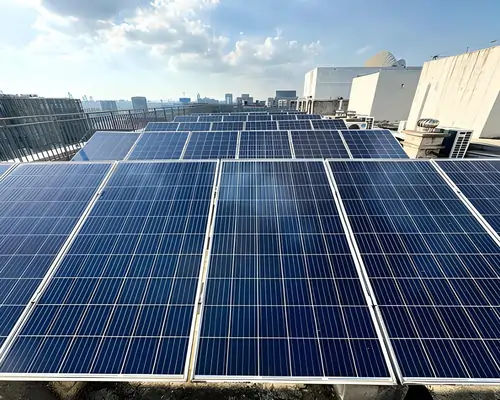
What an On-Grid Solar System Is Designed to Do
For properties with a utility connection and useful daytime consumption, on-grid solar is a straightforward architecture because a battery is not required for normal operation. Solar modules produce DC electricity; the inverter converts it to grid-compatible AC; your loads consume available solar generation, and the grid supplies the balance.
A standard on-grid system should not be treated as a backup-power system. Grid interconnection requires appropriate protection and a distribution licensee can disconnect distributed generation during grid faults; if selected loads must remain powered during outages, a properly designed Hybrid Solar System is the more relevant solution to compare.
How Solar, the Grid and Net Billing Work Together
If consumption is higher than solar production, additional electricity comes from the grid. If an approved system produces eligible surplus, a bidirectional meter records electricity supplied to the distribution company.
Under NEPRA's Prosumer Regulations, 2026, imported electricity is billed at the applicable tariff and exported electricity is credited at the national average energy purchase price. NEPRA may revise that export rate, so a responsible proposal should not promise a permanent export value or automatically promise a “zero electricity bill.”
Pakistan's Current Prosumer Rules
Customers still search for “net metering in Pakistan,” so that phrase belongs naturally on this page—but the legal framework must be explained accurately. NEPRA's Prosumer Regulations, 2026 came into force in February 2026 and repealed the 2015 distributed-generation and net-metering regulations. The current settlement mechanism is described as net billing.
For a prosumer interconnection application, the regulations define an applicant as a three-phase 400 V or 11 kV consumer and cover distributed-generation facilities from 1 kW up to 1 MW. Proposed distributed-generation capacity may not exceed the premises' sanctioned load. Projects of 250 kW or more require a load-flow study, and a licensee will not entertain an application where connected distributed generation on the relevant transformer has reached 80% of rated capacity.
What We Check Before Recommending a System
A useful solar proposal starts with evidence, not a pre-selected package. The assessment should review recent electricity bills, sanctioned load and connection type, daytime load, usable roof or ground area, shading, orientation, cable routes, inverter position, earthing, protection, structural constraints and the applicable distribution-company interconnection position.
Under net billing, self-consumption deserves particular attention because imported and exported electricity are valued under different mechanisms. The right system is therefore not automatically the largest array that fits on a roof.
What You Should Receive Before Approval
Before approving a project, ask for a written scope showing proposed DC capacity and inverter capacity, equipment make and model, mounting approach, AC/DC protection, earthing, monitoring, expected-generation assumptions, exclusions, warranty documents and the exact scope of net-billing assistance.
Savings should be presented as estimates with clearly stated assumptions—not guaranteed rupee amounts.
Our On-Grid Solar Installation Approach
We assess the site and electrical load, design the system around the property and consumption pattern, prepare a written scope, install and test the equipment, configure monitoring, and hand over the relevant documentation.
Where net-billing support is included in the agreed project scope, it should follow the current NEPRA and DISCO process, not old net-metering templates. The PITC Net Billing Portal currently offers consumer and installer application routes and links the participating public DISCOs, including IESCO, FESCO, LESCO, GEPCO, MEPCO, PESCO, HESCO, SEPCO, QESCO, TESCO and HAZECO.
Our long electrical background is important because solar installation is more than mounting panels. Cable sizing, electrical protection, earthing, isolation, distribution-board integration and commissioning all matter to the safety and maintainability of a grid-connected installation.
On-Grid or Hybrid Solar: Which Should You Choose?
Choose on-grid solar when your main objective is reducing grid electricity consumption, daytime demand is meaningful and battery backup is not essential.
Choose hybrid solar when outage backup is a defined requirement, selected circuits must remain operational, or energy storage is part of your operating strategy.
For clarity, Grid Solar Installation should keep these as separate service pages. This page focuses on grid-connected solar and should link directly to the dedicated Hybrid Solar System page for backup-focused customers.
On-Grid Solar System Price in Pakistan
There is no single countrywide price that accurately fits every property. Equipment specification, mounting structure, cable routes, protection, roof conditions, access, sanctioned load, export eligibility and location all affect the project scope.
A “5 kW solar system” label alone does not tell a customer the inverter model, panel capacity, protection equipment, structure, installation standards, warranty, net-billing scope or after-sales responsibility.
Grid Solar Installation should therefore provide a written quote after assessment, or publish only dated indicative price ranges with exact inclusions. Fixed payback and “zero bill” promises should be avoided unless they are supported by the customer's actual bills, tariff category, daytime consumption and current regulatory assumptions.
Why Grid Solar Installation?
Our digital footprint is young, but our installation experience is not.
The owner brings 10 years of solar installation experience and more than 25 years of electrical installation experience, developed largely through builders, contractors, businesses and construction-company networks. We are now bringing that practical background into consumer-facing solar installation in Pakistan.
Our online proof should be simple and verifiable: real project photographs, system specifications, commissioning records, customer-permitted case studies, genuine reviews, and clearly documented warranty and after-sales terms. As the new digital portfolio grows, those records should speak louder than generic marketing claims.
Request an On-Grid Solar Assessment
Share your recent electricity bills, city, property type, connection type if known, and basic property details. After confirming the service location, the project can be assessed for on-grid, hybrid or another suitable solar configuration, followed by a project-specific scope.
For current prosumer requirements, customers should also refer to NEPRA's Prosumer Regulations, 2026 and the PITC Net Billing Portal for the applicable distribution company.