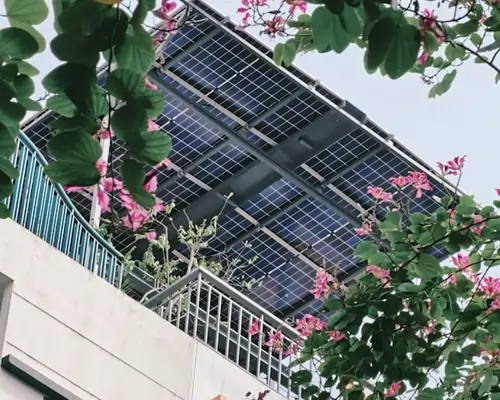
What Is Rooftop Solar?
A rooftop solar system uses photovoltaic solar panels mounted on a residential, commercial or industrial building roof to generate electricity.
The basic system is:
Sunlight → Solar Panels → Inverter → Building Electrical System
Depending on the solar architecture, the electricity can be used through:
On-Grid Rooftop Solar
Solar + Utility Grid
Hybrid Rooftop Solar
Solar + Battery + Utility Grid
Off-Grid Rooftop Solar
Solar + Battery without normal reliance on the utility grid
“Rooftop solar” therefore describes where the solar array is installed, not necessarily how the electrical system operates.
Rooftop Solar vs On-Grid Solar
These terms are often confused.
They are not the same thing.
Rooftop Solar
Describes the physical location of the solar panels.
The modules are installed on a building roof.
On-Grid Solar
Describes the electrical architecture.
The inverter operates in parallel with the utility grid.
An on-grid system can be installed:
-
On a rooftop
-
On the ground
-
On a solar carport
Similarly, a rooftop installation can be:
Understanding this distinction helps customers choose the right system rather than assuming every rooftop installation is automatically a net-metering system.
What Types of Roofs Can Be Used for Solar?
Solar panels can potentially be installed on different roof types, subject to site-specific assessment.
These may include:
However, having a roof does not automatically make it suitable for solar.
The roof's:
condition + structure + available area + shading + geometry + future use
all matter.
The First Question Should Be: Is the Roof Suitable?
Before deciding panel quantity, the roof itself needs attention.
The U.S. Department of Energy recommends evaluating roof condition and structural ability before rooftop solar installation. It also advises considering whether roof repair or replacement will be needed during the life of the solar system.
At Grid Solar Installation, we therefore believe the correct sequence is:
Assess Roof → Assess Load → Design Array → Install Solar
not:
Sell Panels → Find Somewhere to Put Them
Roof Condition Before Solar Installation
Solar panels can remain on a roof for many years.
That means installing a long-life solar array over a roof already approaching major repair can create unnecessary future cost.
Before installation, signs that may require further roof assessment can include:
-
Water leakage
-
Severe cracking
-
Corrosion
-
Deteriorated waterproofing
-
Significant sagging
-
Damaged roofing sheets
-
Weak structural members
-
Previous unprofessional alterations
-
Areas requiring frequent repairs
DOE guidance specifically recommends assessing roof age and condition before installing rooftop PV.
Where substantial roof work is already expected soon, it may make more sense to address that work before solar installation.
Why Structural Suitability Matters
Solar panels add more than module weight to a roof.
The complete rooftop system can include:
-
Solar modules
-
Mounting rails
-
Structural supports
-
Ballast where applicable
-
Cable trays
-
Walkways
-
Electrical equipment
-
Wind-induced forces
The roof therefore needs to safely support the selected system.
A structural assessment may consider:
For larger commercial and industrial installations, structural engineering may become particularly important.
Grid Solar Installation does not recommend assuming that every concrete, metal or shed roof can accept unlimited solar capacity.
Rooftop Solar on RCC / Concrete Roofs
Reinforced concrete roofs are common for residential and commercial buildings in Pakistan.
Possible mounting approaches depend on project design.
Important considerations can include:
-
Roof slab condition
-
Existing waterproofing
-
Parapet height
-
Water tanks
-
Stair rooms
-
Roof access
-
Drainage
-
Structural loading
-
Wind
-
Panel tilt
-
Maintenance pathways
One advantage of many flat roofs is flexibility in solar-panel layout.
However, poor placement can create unnecessary shading or obstruct roof use.
Rooftop Solar on Metal and Industrial Shed Roofs
Factories and warehouses commonly use metal roofing systems.
These roofs require different mounting considerations from concrete roofs.
A site assessment may need to examine:
-
Roofing profile
-
Sheet condition
-
Purlin spacing
-
Structural frame
-
Existing corrosion
-
Fastener condition
-
Roof slope
-
Waterproofing
-
Wind exposure
-
Safe worker access
Mounting hardware should be appropriate for the actual roof system.
Panels should not simply be attached wherever a fixing point is easiest.
Roof Penetrations and Waterproofing
Customers often ask:
“Will solar panels cause my roof to leak?”
A properly designed installation should take waterproofing seriously.
Some mounting systems involve roof penetrations.
Others may use different structural approaches depending on roof type.
Where penetrations are required, they should be properly detailed and weatherproofed.
DOE commercial rooftop guidance recommends minimising necessary penetrations where practical and ensuring weatherproofing remains compatible with the underlying roofing system.
Solar installation should not convert a good roof into a leaking roof.
Does Rooftop Solar Affect Roof Drainage?
A solar array should not unnecessarily block existing drainage.
Before installation, the layout should consider:
-
Roof drains
-
Gutters
-
Downpipes
-
Natural water flow
-
Low areas
-
Existing slopes
-
Waterproofing details
DOE's commercial rooftop solar guidance recommends designing arrays so roof drainage remains functional and maintenance personnel can still access roof systems.
That is particularly important on large flat roofs.
Solar panels should not create inaccessible areas where standing water becomes difficult to inspect or repair.
Shading Analysis for Rooftop Solar
Not all roof space is equally useful.
Possible shading sources include:
-
Water tanks
-
Stair rooms
-
Parapet walls
-
Nearby buildings
-
Trees
-
Antennas
-
HVAC equipment
-
Billboards
-
Other solar arrays
Shading changes according to:
-
Time of day
-
Season
-
Sun angle
A roof area that looks clear at midday may be shaded during morning or afternoon solar-production periods.
DOE also identifies shade, roof orientation and roof geometry as key factors in determining rooftop solar potential.
This is why usable roof area matters more than total roof area.
Total Roof Area vs Usable Solar Area
Suppose a property has:
2,000 sq. ft. total roof area.
That does not mean 2,000 sq. ft. is available for solar panels.
Space may also be required for:
-
Water tanks
-
Stairs
-
HVAC
-
Roof access
-
Drainage
-
Maintenance pathways
-
Existing equipment
-
Future equipment
-
Shading clearance
The correct question is:
How much technically usable, sufficiently unshaded roof area is available?
That is the area that matters for PV design.
Rooftop Solar Panel Orientation
Solar-panel orientation affects when and how much electricity the system produces.
A rooftop layout may be constrained by:
-
Roof shape
-
Building orientation
-
Shading
-
Available area
-
Parapets
-
Structural conditions
The goal is not necessarily to force every panel into one textbook orientation.
A professional design should consider the complete roof and energy objective.
In some projects, maximising annual generation is the main priority.
In others, matching production more closely to daytime electricity consumption may also matter.
Solar Panel Tilt
Panel tilt can influence:
-
Solar exposure
-
Self-shading
-
Wind loading
-
Water runoff
-
Cleaning
-
Row spacing
-
Structural requirements
A flat roof gives designers flexibility to select panel tilt.
But higher tilt is not automatically better.
Increasing tilt may:
The final design should balance generation, structure and available roof area.
Row Spacing and Self-Shading
On flat roofs, tilted rows can shade the rows behind them.
If panels are placed too close together, this can reduce energy production during certain hours and seasons.
The designer should therefore consider:
-
Panel dimensions
-
Tilt
-
Row spacing
-
Solar angle
-
Roof boundaries
-
Maintenance access
Packing the maximum number of modules onto a roof can sometimes produce a worse system than installing fewer panels with a better layout.
Wind Load and Rooftop Solar
Solar panels are exposed to wind.
Wind can create:
Roof-edge and corner areas can experience different wind conditions from central roof areas.
The mounting structure and connection to the building therefore need to be designed appropriately for the project conditions.
DOE commercial PV guidance specifically identifies wind loading as one of the factors rooftop solar support systems must address.
A solar structure should not be selected solely because it is the cheapest steel option.
Maintenance Access Around Rooftop Solar Panels
A roof may still need maintenance after solar installation.
Access can be needed for:
DOE rooftop guidance recommends maintaining physical access to the roof and existing rooftop systems after PV installation.
The panel layout should therefore consider future technicians—not only the installation team working today.
Why We Do Not Recommend Covering Every Inch of Roof
An array that uses every possible centimetre of roof area may look impressive on a quotation.
It can create operational problems later.
Possible issues include:
A technically good layout leaves appropriate space where it is actually required.
Maximum panel count is not always maximum system quality.
Rooftop Solar and Fire / Emergency Access
Large rooftop arrays should be planned with emergency access in mind.
The exact requirements depend on the type of building and applicable local standards.
However, good design should avoid creating a rooftop environment where responders or maintenance personnel have no practical route around the system.
DOE commercial rooftop PV guidance specifically identifies access and fire-safety considerations as part of responsible rooftop PV layout.
For larger buildings, access planning should be included before final panel layout.
Residential Rooftop Solar Installation
Residential rooftop solar can provide electricity for daytime household loads such as:
-
Air conditioners
-
Fans
-
Refrigerators
-
Water pumps
-
Lighting
-
Computers
-
Appliances
The system can be designed as:
On-Grid
for customers mainly focused on daytime self-consumption,
Hybrid
where battery backup is also required,
or:
Off-Grid
where the property needs to operate without normal grid dependence.
A residential rooftop system should be sized from electricity consumption and load profile—not from house size alone.
Rooftop Solar for Large Homes
Large homes may have:
These properties may require a more detailed load analysis.
A large roof does not automatically mean a very large on-grid system is the correct choice.
Daytime consumption and battery requirements should also be considered.
Commercial Rooftop Solar Installation
Commercial rooftop solar can be used for:
-
Offices
-
Shops
-
Retail stores
-
Schools
-
Hospitals
-
Hotels
-
Warehouses
-
Commercial plazas
Commercial properties often have significant daytime electricity use.
That can align well with solar generation.
Important design inputs include:
Industrial Rooftop Solar Installation
Factories and industrial facilities can have some of the largest available rooftop areas.
But industrial rooftop solar should not be designed from roof area alone.
A professional assessment can include:
-
Electricity bills
-
Maximum demand
-
Production shifts
-
Transformer capacity
-
Sanctioned load
-
Motors
-
Machinery
-
Roof structure
-
Shed construction
-
Inverter locations
-
Cable routes
-
Grid integration
Large industrial roofs can support substantial solar arrays physically, while the most financially appropriate PV size may still depend on the factory's load.
Warehouse Rooftop Solar
Warehouses can provide excellent physical space for PV because of large roof areas.
However, their loads vary considerably.
A basic dry-storage warehouse may consume relatively little electricity compared with the array capacity its roof could physically support.
A refrigerated or logistics warehouse may use substantial electricity for:
-
Cooling
-
Compressors
-
Conveyors
-
Lighting
-
Offices
-
Charging equipment
This is why:
Roof capacity is not the same thing as required solar capacity.
Load analysis comes first.
Office Rooftop Solar
Office buildings are often good candidates for direct solar self-consumption because much of their electricity consumption occurs during daylight.
Typical loads include:
-
Air conditioning
-
Computers
-
Servers
-
Networking
-
Lighting
-
Elevators
-
Pumps
Where backup is also required, a Hybrid Solar System can be evaluated.
Rooftop Solar for Retail Properties
Retail facilities may have high daytime loads from:
-
Cooling
-
Lighting
-
Refrigeration
-
POS equipment
-
Displays
-
Computers
Because these loads operate while solar energy is available, correctly sized rooftop PV may achieve useful self-consumption.
Again, the objective should not automatically be maximum grid export.
Solar Roof Capacity Starts With Load Analysis
Before determining rooftop solar capacity, Grid Solar Installation recommends reviewing:
Only after understanding the electricity requirement should we compare that requirement with usable roof space.
How Much Rooftop Solar Do I Need?
There is no responsible universal answer based only on roof size.
Correct capacity depends on:
Energy consumption
How many kWh does the property use?
Load timing
How much consumption occurs while solar is producing?
Peak demand
What is the maximum electrical power required?
Roof potential
How much usable, sufficiently unshaded area exists?
System architecture
On-grid, hybrid or off-grid?
Battery requirement
How much backup is needed?
Grid connection
What electrical and regulatory limits apply?
A 10 kW system should be installed because the analysis supports approximately that capacity—not simply because “10 kW is a popular package.”
Rooftop Solar in Pakistan After the 2026 Net-Metering Changes
Pakistan's regulatory environment for new grid-connected solar changed significantly in 2026.
The NEPRA Prosumer Regulations 2026 were notified on February 9, 2026, and NEPRA's current legal register lists subsequent amendments during the same year.
For qualifying new prosumer projects, solar-system economics should be assessed under the current framework rather than older assumptions about traditional one-for-one net metering.
This makes correct rooftop sizing even more important.
Our Rooftop Solar Strategy in 2026: Self-Consumption First
Grid Solar Installation recommends designing new rooftop solar systems primarily around electricity that can be productively consumed by the customer.
Our preferred order is:
1. Understand the Load
Know how much electricity is actually being consumed.
2. Understand When It Is Consumed
Daytime and nighttime energy have different implications.
3. Design the Rooftop Array
Use the useful roof area to meet the identified requirement.
4. Shift Flexible Loads Where Practical
Move suitable electricity consumption into solar-production hours.
5. Consider Batteries When They Solve a Real Problem
Battery storage can help with backup or nighttime consumption but should be financially and technically justified.
6. Treat Grid Export as Secondary
Approved grid export may still provide value, but we do not recommend oversizing solely because roof space is available.
Our Position on Net Metering
Grid Solar Installation's experience-based view for new projects in 2026 is:
Traditional net metering is effectively over for new prosumer applications, so rooftop solar should be designed primarily for useful self-consumption rather than dependence on future grid-export incentives.
NEPRA's 2026 prosumer framework replaced the previous regulatory structure, and the regulatory framework has already undergone amendments during 2026.
No installer can responsibly guarantee what future government policy will be.
Our recommendation is therefore to make the system economically useful based on today's requirements.
If future export policy improves, that can be an additional advantage.
On-Grid Rooftop Solar
An on-grid rooftop system typically operates as:
Solar → Building Load
When solar is insufficient:
Solar + Grid → Building Load
Where approved surplus exists:
Surplus Solar → Grid
This configuration can make sense for properties with substantial daytime consumption.
A conventional on-grid system generally does not provide backup during a utility outage.
Hybrid Rooftop Solar
Hybrid rooftop solar combines:
Solar + Battery + Grid
This can provide:
-
Daytime solar consumption
-
Battery charging
-
Backup for selected loads
-
Evening solar use
-
Additional energy-management flexibility
Battery storage should be sized from:
Backup Load × Required Time
not simply from rooftop solar capacity.
A 15 kW rooftop array does not automatically require a particular battery size.
Off-Grid Rooftop Solar
An off-grid rooftop system operates without normal dependence on utility electricity.
It normally requires careful design around:
Off-grid solar is not automatically better simply because net-billing rules have changed.
Where a reliable grid exists, keeping the grid as an additional energy source may still be practical.
Three-Phase Rooftop Solar
Larger homes, offices, shops and industrial properties may have three-phase electricity.
Three-phase rooftop design may need to consider:
Grid Solar Installation's 25+ years of electrical installation experience is particularly relevant where rooftop solar must be integrated into complex three-phase electrical systems.
Solar Panel Mounting Structure
The mounting structure connects the PV array to the roof.
A good structure should consider:
-
Module dimensions
-
Roof type
-
Structural loads
-
Wind
-
Corrosion environment
-
Panel tilt
-
Row spacing
-
Maintenance
-
Fixing method
The structure should not be selected only according to lowest price.
It needs to remain mechanically appropriate for the actual installation.
Ballasted vs Anchored Rooftop Solar
Some flat commercial-roof systems can use ballasted mounting, anchored systems or combinations of both depending on engineering conditions.
DOE commercial rooftop guidance describes ballasted systems as structures held by added weight, while anchored systems transfer loads through physical roof connections. The appropriate solution depends on roof load capacity and wind requirements.
This decision should be made from actual roof conditions.
Grid Solar Installation does not assume one mounting style is suitable for every roof.
Rooftop Solar Cable Routing
A clean rooftop layout includes sensible cable planning.
Important considerations include:
-
Cable length
-
DC voltage
-
Current
-
UV exposure
-
Mechanical protection
-
Sharp edges
-
Water routes
-
Cable trays
-
Roof penetrations
-
Inverter location
Cables should not be left loosely across roof areas where people walk or water regularly collects.
Cable design affects both safety and long-term maintainability.
Inverter Location
The rooftop array may be on the roof.
That does not automatically mean the inverter should be installed in the hottest exposed place beside it.
Inverter location should consider manufacturer requirements as well as:
-
Heat
-
Ventilation
-
Sun exposure
-
Rain
-
Dust
-
Security
-
Accessibility
-
DC cable distance
-
AC cable distance
The easiest installation location is not always the best operating location.
Electrical Protection
Rooftop solar introduces both DC and AC electrical circuits.
Depending on system architecture, protection can include:
Electrical protection should be designed around actual current, voltage and system conditions.
Solar panels alone do not make a complete solar installation.
Earthing and Bonding
Mounting structures and electrical equipment need to be considered within the property's appropriate earthing and bonding strategy.
This is important for:
Earthing should be part of the initial design.
It should not be added as an afterthought after the panels are already installed.
What Happens to Rooftop Solar During Load Shedding?
This depends on system type.
Conventional On-Grid Rooftop Solar
The inverter generally disconnects when grid electricity fails.
Sunlight alone does not guarantee that the property remains powered.
This anti-islanding behavior prevents inappropriate energisation of the utility network.
Hybrid Rooftop Solar
A properly designed hybrid system can continue supplying designated backup loads from available solar and battery energy.
The customer should know before installation:
Hybrid does not automatically mean unlimited whole-building backup.
Rooftop Solar Panel Cleaning
Solar panels operate outdoors and can accumulate:
-
Dust
-
Pollution
-
Bird droppings
-
Mud
-
Construction dust
Cleaning requirements vary by site conditions.
A rooftop layout should therefore make reasonable future cleaning access possible.
Installing panels so tightly that safe access becomes impossible can increase maintenance difficulty throughout the life of the system.
Rooftop Solar Monitoring
Compatible solar inverters can provide monitoring data such as:
Monitoring gives customers visibility into system operation.
It can also help distinguish:
normal seasonal change
from:
possible system underperformance.
Rooftop Solar System Price in Pakistan
There is no responsible single rooftop solar price.
Cost depends on factors including:
-
Solar capacity
-
Panel specifications
-
Inverter type
-
On-grid or hybrid architecture
-
Battery capacity
-
Roof type
-
Mounting structure
-
Structural requirements
-
Cable distances
-
Electrical protection
-
Existing electrical system
-
Access
-
Grid-interconnection scope
-
Installation complexity
For example, installing 20 kW on an easily accessible concrete roof is a different project from installing the same capacity on an industrial shed requiring specialised structure and long cable routes.
The same headline kW does not guarantee the same project scope.
What Should a Rooftop Solar Quotation Include?
When comparing quotations, ask for clarity about:
-
Proposed PV capacity
-
Panel quantity and rating
-
Inverter capacity
-
System type
-
Expected energy production
-
Mounting structure
-
Roof assumptions
-
Electrical protection
-
AC/DC cabling
-
Earthing
-
Monitoring
-
Battery capacity where applicable
-
Grid interconnection scope
-
Installation exclusions
-
Equipment warranty terms
-
Installer workmanship terms
The cheapest quotation may simply exclude work that appears in another installer’s price.
Compare scope, not just the final number.
Common Rooftop Solar Installation Mistakes
Installing Before Checking Roof Condition
Future roof repair may require removing the array.
Using Total Roof Area Instead of Usable Roof Area
Shading, access and rooftop equipment reduce actual PV space.
Installing Too Close to Obstructions
This can create avoidable shading.
Blocking Roof Drainage
Water management needs to remain functional.
Ignoring Waterproofing
Poorly treated penetrations can create leakage risks.
Ignoring Wind Loads
The mounting structure needs to withstand site conditions.
Leaving No Maintenance Access
Technicians should be able to safely inspect and maintain the array.
Poor Cable Routing
Loose, exposed or badly planned cables reduce system quality.
Oversizing Because the Roof Is Large
Useful load should drive capacity.
Ignoring Existing Electrical Infrastructure
Distribution boards, generators, UPS systems and three-phase loads need to be considered.
Assuming Solar Automatically Provides Backup
Conventional on-grid rooftop solar generally does not.
When Rooftop Solar May Not Be the Best Option
We do not believe rooftop solar should be forced onto every building.
Another installation method may be better when:
-
Roof condition is poor
-
Roof replacement is planned soon
-
Structural capacity is unsuitable
-
Severe shading exists
-
Roof space is limited
-
Roof area is needed for another operational purpose
-
Large open land is available
-
A large parking area is available
In those situations, we may evaluate:
Solar Carports
or:
Ground-Mounted Solar Systems
A professional solar company should be willing to tell a customer when the roof is not the best location.
Rooftop vs Solar Carport vs Ground Mount
Rooftop Solar
Best considered when suitable building roof space is available.
Advantages
-
Uses existing building space
-
Does not require separate land
-
Can be close to electrical loads
-
Suitable for residential and commercial properties
Solar Carport
Best considered where usable parking areas are available.
Advantages
Ground Mount
Best considered where suitable open land is available.
Advantages
-
Flexible orientation
-
Easier maintenance access in many designs
-
Potential future expansion
-
Less dependence on roof condition
The best option depends on the actual site.
Our Rooftop Solar Installation Process
Step 1 — Understand Your Objective
We first establish whether the primary goal is:
Step 2 — Review Electricity Consumption
Where available, we review up to 12 months of electricity bills and the property's load profile.
Step 3 — Roof Survey
We assess:
-
Roof condition
-
Available space
-
Shading
-
Access
-
Obstacles
-
Drainage
-
Installation constraints
Step 4 — Structural Consideration
The proposed array and mounting system are assessed against the actual roof conditions, with additional specialist structural assessment where required.
Step 5 — Solar Layout
We determine appropriate:
-
Panel location
-
Orientation
-
Tilt
-
Row spacing
-
Maintenance access
Step 6 — System Design
We select the appropriate:
Step 7 — Electrical Protection Design
The AC, DC, earthing and associated protection requirements are established.
Step 8 — Proposal
The customer receives the proposed technical and commercial scope.
Step 9 — Rooftop Installation
The mounting system and solar modules are installed according to the agreed layout and roof conditions.
Step 10 — Electrical Installation
The inverter, wiring, protection and property connection are completed according to the system design.
Step 11 — Testing and Commissioning
The completed system is tested before handover.
Step 12 — Customer Handover
The customer should understand:
Why Grid Solar Installation?
Rooftop solar requires understanding both the roof and the electrical system beneath it.
Grid Solar Installation brings 10 years of solar installation experience and more than 25 years of electrical installation experience.
Our website and digital presence are relatively new.
Our practical experience is not.
Before expanding digitally, much of our work developed through professional relationships with builders, businesses and construction companies.
That background shapes how we approach rooftop solar.
We do not begin with:
“How many panels can we sell?”
We begin with:
“What does this property need, and what can this roof support effectively?”
Our approach is:
Load Analysis + Roof Assessment + Solar Layout + Electrical Design + Installation + Testing
Our Rooftop Solar Philosophy
A good rooftop solar installation should achieve more than high panel count.
It should provide:
Useful Solar Generation
The system should generate energy the customer can productively use.
Suitable Roof Integration
The array should respect the existing building.
Safe Structural Support
The mounting system should suit the roof and site conditions.
Maintainable Layout
Roof drainage, access and future maintenance should remain practical.
Proper Electrical Integration
The PV system should work safely with the building's existing electrical infrastructure.
Realistic Financial Logic
The project should not depend entirely on uncertain future grid-export incentives.
Request a Rooftop Solar Assessment
If you are considering rooftop solar for a home, office, shop, warehouse, factory or another property, useful information includes:
-
Property location
-
Property type
-
Recent electricity bills
-
Single-phase or three-phase connection
-
Sanctioned load if known
-
Daytime electricity use
-
Backup requirements
-
Existing generator or UPS
-
Roof type
-
Approximate roof dimensions
-
Age or condition of roof if known
-
Any known leakage or structural issue
-
Water tanks and rooftop equipment
-
Existing solar system if any
-
Planned building expansion
-
Photographs or roof drawings where available
Grid Solar Installation can then assess the electrical requirement, usable roof area and appropriate solar architecture before recommending system capacity.