Why Do Solar Panels Need Cleaning?
Solar panels generate electricity when sunlight reaches photovoltaic cells.
When dust and other material accumulates on the module glass, some incoming sunlight can be blocked or scattered.
This is known as soiling.
Soiling can include:
IEA PVPS identifies soiling as an important cause of PV-system underperformance. Its 2025 fact sheet estimates average worldwide energy losses from soiling at roughly 4–7%, while emphasizing that actual losses vary considerably by climate, site and operating conditions.
This is why Grid Solar Installation does not promise that cleaning will improve every system by an arbitrary percentage.
The benefit should be judged from the actual condition of the solar array.
Solar Panel Cleaning Is Especially Important in Dusty Conditions
Pakistan contains many environments where solar panels can accumulate substantial dust.
Factors can include:
Pakistan-specific research demonstrates why cleaning deserves attention.
A study conducted in Lahore measured substantial soiling during dry-season testing and concluded that cleaning requirements were strongly dependent on tilt angle and local environmental conditions.
More recently, a 2026 study conducted in Islamabad measured dust accumulation on PV modules and reported significant recovery of lost power after cleaning during its experimental periods.
These studies should not be interpreted as meaning every solar system in Pakistan loses the same percentage.
They demonstrate something more useful:
Solar-panel soiling in Pakistan can be significant, and cleaning schedules should be based on local conditions rather than one universal rule.
How Dirty Solar Panels Reduce Electricity Generation
Dust affects solar generation mainly by reducing the amount of useful sunlight reaching the cells.
Imagine a clean window.
More light passes through.
Now cover part of that window with dust, mud or bird droppings.
Less light passes through.
A solar module is more technically complex, but the basic principle is similar.
When contamination covers the module surface:
Available Sunlight ↓
which can contribute to:
Solar Output ↓
The amount of reduction depends on:
-
Dust density
-
Dust composition
-
Module tilt
-
Rainfall
-
Wind
-
Pollution
-
Duration since cleaning
-
Panel design
-
Uneven contamination
-
Local shading
-
Weather
This is why visual appearance alone does not always tell the complete story.
Does Cleaning Solar Panels Really Improve Performance?
It can, when soiling is responsible for reduced output.
However, cleaning cannot fix every solar-performance problem.
Low solar production can also result from:
-
Cloudy weather
-
Seasonal solar variation
-
Shading
-
Inverter limitations
-
String faults
-
Grid conditions
-
Wiring problems
-
Equipment faults
-
Module damage
-
Temperature
-
System clipping
-
Incorrect system design
Therefore, if generation remains low after panels are cleaned, the system may need technical inspection rather than more cleaning.
This distinction is important.
Cleaning solves soiling.
It does not solve every electrical or design problem.
How Often Should Solar Panels Be Cleaned in Pakistan?
There is no scientifically responsible universal cleaning interval for every solar installation.
You may see recommendations online such as:
-
Every week
-
Every 15 days
-
Every month
-
Every three months
None should automatically apply to every property.
IEA PVPS emphasizes that soiling is highly heterogeneous and that cleaning decisions should reflect site-specific conditions.
Cleaning frequency depends on factors including:
Location
A property beside an unpaved road can accumulate dust much faster than a cleaner suburban site.
Season
Long dry periods may require more attention than rainy periods.
Construction Activity
Nearby construction can significantly increase airborne dust.
Panel Tilt
Panels installed at different angles may accumulate and retain different amounts of contamination.
Rainfall
Meaningful rainfall may remove some loose contamination, although rain should not automatically be treated as a complete professional cleaning.
Bird Activity
Bird droppings may require localised cleaning even when the rest of the array appears relatively clean.
Industrial Pollution
Warehouses and factories in industrial areas may experience different types of deposits from residential sites.
Agricultural Conditions
Dust from soil, crops and surrounding activity can influence cleaning requirements.
System Economics
For a large commercial solar plant, even a relatively small percentage of recoverable lost generation can represent meaningful energy.
Our Preferred Approach: Condition-Based Cleaning
Instead of telling every customer:
“Clean your panels every 15 days.”
we prefer a more practical approach.
Look at:
This approach is particularly important for larger commercial and industrial systems.
Cleaning itself costs money.
The goal should therefore be:
clean often enough to control meaningful soiling losses without performing unnecessary maintenance.
Signs Your Solar Panels May Need Cleaning
Consider inspecting the system when you notice:
Visible Dust Layer
A clearly visible layer of dust has formed across the modules.
Bird Droppings
Localised bird contamination can create substantial obstruction over small areas.
Mud or Rain Residue
Light rain combined with dust can sometimes create dirty deposits rather than leaving the glass completely clean.
Construction Dust
Nearby building or road construction can cause rapid soiling.
Unexpected Reduction in Generation
If solar output appears lower than expected under similar weather conditions, soiling may be one factor worth investigating.
Long Dry Period
Extended periods without significant rainfall can allow contamination to build up.
Uneven Panel Appearance
Some rows or modules may soil differently because of their position, tilt or surrounding environment.
What Is Included in Professional Solar Panel Cleaning?
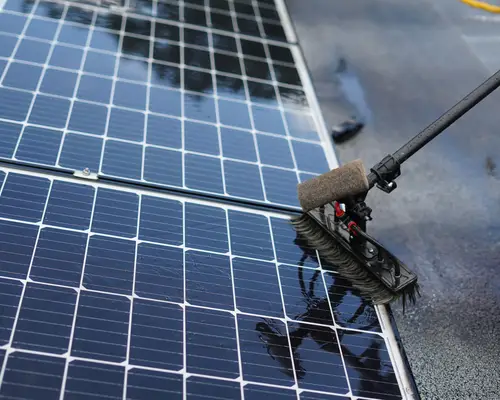
A professional solar cleaning service should involve more than wetting the modules.
Our performance-focused approach can include the following stages according to the system and site conditions.
1. Visual Solar Array Check
Before cleaning, the array should be visually checked for obvious conditions such as:
-
Broken glass
-
Loose-looking components
-
Exposed wiring
-
Significant cable damage
-
Severe contamination
-
Bird nests
-
Physical obstacles
-
Unusual shading
Cleaning should not proceed normally where damaged modules or exposed electrical parts create a safety concern.
JinkoSolar's maintenance guidance specifically warns against attempting to clean modules with broken glass or exposed wiring because of electrical-shock risk.
2. Assess the Type of Soiling
Not every contaminant should be treated identically.
Loose dust may require a different approach from:
-
Bird droppings
-
Mud
-
Sticky organic deposits
-
Mineral deposits
-
Industrial contamination
The objective is to remove contamination without unnecessarily damaging the module surface or coating.
3. Clean During Suitable Conditions
Cleaning extremely hot solar modules with significantly cooler water can create unnecessary thermal stress.
Major module manufacturers recommend cleaning during cooler, lower-irradiance periods such as the early morning or late afternoon, particularly in hot climates.
This also reduces thermal and electrical risk for the person performing the work.
4. Use Module-Safe Cleaning Tools
Solar-module glass should not be treated like a concrete floor.
Manufacturer guidance commonly recommends soft cleaning materials.
Suitable tools may include manufacturer-compatible:
Sharp or abrasive materials should not be used.
LONGi specifically warns against tools such as blades, metal scouring materials and other abrasive cleaning products because they may damage the module surface.
5. Use Appropriate Water
Water quality matters.
Water with high mineral content can leave deposits after evaporation.
Both LONGi and JinkoSolar maintenance guidance discuss water-quality considerations and warn that mineral-rich water can leave residue on module glass.
The appropriate water and cleaning method should follow the specific module manufacturer's maintenance requirements.
We do not recommend making a universal claim that every solar panel requires one particular water type without first checking the installed modules and site conditions.
6. Avoid Harsh Chemicals
Solar-module glass may contain coatings intended to support optical performance.
Household cleaning chemicals are not automatically suitable for PV modules.
Manufacturer guidance warns against abrasive or inappropriate chemical cleaners.
LONGi, for example, prohibits abrasive cleaners and a range of aggressive chemical substances in its maintenance guidance, while JinkoSolar advises against chemicals that may affect module warranty or performance.
The module manufacturer's instructions should take priority.
7. Avoid Uncontrolled High-Pressure Cleaning
A pressure washer should not automatically be aimed at solar modules at maximum pressure.
Excessive pressure can potentially affect:
-
Module seals
-
Connections
-
Frames
-
Glass
-
Junction areas
Manufacturer pressure limits differ.
If pressurised water is used, the actual module manufacturer's allowable pressure and cleaning instructions should be checked first.
Solar Panel Cleaning and Electrical Safety
A solar array is live electrical-generation equipment whenever sufficient sunlight is available.
It should not be treated like an ordinary roof window.
Solar panels can continue producing DC voltage while being cleaned.
Important hazards can include:
-
Damaged cables
-
Exposed conductors
-
Broken module glass
-
Wet electrical equipment
-
Roof falls
-
Slippery surfaces
-
Hot modules
-
Unsafe access
Do not assume that turning off an inverter makes every part of the solar array electrically dead.
This is one reason professional maintenance is particularly valuable for rooftop, commercial and industrial installations.
Do Not Walk on Solar Panels
Solar modules are not designed to serve as walking surfaces.
Walking, kneeling or putting concentrated body weight on a module may cause:
-
Glass damage
-
Cell microcracking
-
Frame stress
-
Hidden internal damage
Even where damage is not immediately visible, unnecessary mechanical stress should be avoided.
Cleaning equipment and access planning should allow technicians to work without treating modules as platforms.
Solar Panel Cleaning for Homes
Residential systems may require cleaning because of:
-
Road dust
-
Construction
-
Birds
-
Trees
-
Dry weather
-
Nearby empty plots
-
Pollution
A homeowner should pay particular attention to safe roof access.
The value of cleaning should also be considered against system size.
For a small system, a dangerous DIY rooftop climb is not justified simply to remove a light layer of dust.
Safety comes first.
Commercial Solar Panel Cleaning
Commercial systems may be installed on:
Because these systems can have larger arrays, cleaning planning becomes more important.
Commercial maintenance should consider:
For larger systems, unnecessary cleaning can increase operating cost.
Insufficient cleaning can reduce energy yield.
The goal is to balance both.
Industrial Solar Panel Cleaning
Industrial solar power plants may contain hundreds or thousands of modules.
At this scale, cleaning becomes an operations and maintenance decision rather than simply a cosmetic service.
Industrial cleaning planning may consider:
The 2025 IEA PVPS soiling fact sheet specifically emphasizes optimising cleaning schedules and using site-specific mitigation strategies rather than relying on universal cleaning intervals.
Warehouse Solar Panel Cleaning
Warehouses can have very large rooftop arrays.
Their roof environments may also experience:
-
Road dust
-
Logistics traffic
-
Industrial pollution
-
Exhaust
-
Nearby construction
-
Bird activity
Cleaning strategy should consider the size of the solar array as well as the electricity value being recovered.
Where monitoring is available, performance data can help identify whether cleaning frequency should be adjusted.
Solar Panel Cleaning for Factories
Factory environments can create special contamination conditions.
Depending on the industry, airborne material may include:
Standard water cleaning may not always be sufficient for unusual deposits.
Before using specialised chemicals or equipment, the module manufacturer's maintenance requirements should be reviewed.
Cleaning Bifacial Solar Panels
Bifacial modules can generate electricity from light reaching both the front and rear sides of the module.
Whether the rear surface requires cleaning depends on:
-
Installation design
-
Module type
-
Mounting height
-
Dust conditions
-
Ground conditions
-
Accessibility
-
Manufacturer guidance
Rear-side contamination should not automatically be ignored on bifacial installations.
However, cleaning methods should remain compatible with the specific module manufacturer.
Should Solar Panels Be Cleaned After Rain?
Sometimes yes, sometimes no.
A strong rain event may remove a substantial amount of loose dust.
However, rain can also interact with existing contamination and leave:
Therefore:
Rain does not automatically mean the solar panels are perfectly clean.
Inspect the actual module condition and performance.
Can I Clean Solar Panels Myself?
For safely accessible systems, some manufacturers provide instructions for basic owner maintenance.
However, DIY cleaning becomes a poor choice where:
-
The array is on a high roof
-
Roof access is unsafe
-
Panels are difficult to reach
-
Electrical wiring appears damaged
-
Glass is cracked
-
Special cleaning equipment is required
-
The system is large
-
The contamination is difficult to remove
The value of a few recovered solar units is never worth a serious roof or electrical accident.
Common Solar Panel Cleaning Mistakes
Cleaning Panels at the Hottest Time of Day
Hot modules and cold water can create unnecessary thermal stress.
Using Abrasive Brushes
Rough materials can damage module surfaces.
Using Random Household Chemicals
Cleaning agents may interact with coatings or conflict with manufacturer requirements.
Using Excessive Water Pressure
High-pressure washing should not be used without understanding manufacturer limits.
Walking on Panels
Solar modules are not working platforms.
Cleaning Cracked Modules
Broken glass or exposed wiring can create an electrical hazard.
Ignoring Water Quality
Mineral-rich water can leave deposits on module glass.
Assuming Every Performance Problem Is Dust
Low production can also indicate electrical, inverter, shading or design problems.
Solar Panel Cleaning vs Solar Maintenance
Cleaning and maintenance are related, but they are not identical.
Solar Panel Cleaning
Primarily addresses surface contamination such as:
-
Dust
-
Dirt
-
Bird droppings
-
Mud
-
Other deposits
Solar System Maintenance
Can involve broader checks such as:
-
Inverter condition
-
Connectors
-
Cabling
-
Earthing
-
Mounting
-
Monitoring
-
Protection equipment
-
Generation performance
Cleaning should therefore be considered one part of the wider solar O&M process.
Why Cleaning Alone May Not Fix Low Solar Production
Suppose your system was previously producing normally.
You clean the panels.
But generation remains unexpectedly low.
Possible causes could include:
At that point, continuing to wash the panels is unlikely to solve the real problem.
A technical solar inspection may be more appropriate.
Monitor Solar Performance Before and After Cleaning
Where reliable monitoring data is available, it can provide useful evidence.
Look at comparable operating conditions before and after cleaning.
For example:
Do not compare one cloudy day before cleaning against a clear day afterward and conclude that the entire difference came from cleaning.
Performance analysis should account for weather conditions.
For large commercial systems, soiling monitoring can become part of a more formal O&M strategy.
How Much Electricity Can Solar Panel Cleaning Recover?
There is no universal answer.
IEA PVPS estimates global soiling losses across PV systems in the range of roughly 4–7% on average, but actual site losses vary widely.
Pakistan-specific studies show why fixed percentages should be avoided.
A Lahore study found high soiling during its specific dry-season experiment.
A 2026 Islamabad experiment reported power recovery of approximately 11–15% after cleaning under its particular testing conditions and module tilt angles.
These are research findings—not promises for your system.
Your result could be:
depending on your installation.
Grid Solar Installation does not recommend advertising a guaranteed percentage increase from cleaning without first assessing the system.
Solar Panel Cleaning Price in Pakistan
There is no responsible universal cleaning price because the work required can vary substantially.
Factors may include:
For example, cleaning twelve safely accessible residential modules is a very different job from cleaning a 500 kW commercial rooftop array.
A quotation should therefore reflect the actual site.
Is Professional Solar Cleaning Worth the Cost?
The answer depends on the system.
For a large commercial or industrial system, relatively small recoverable generation losses can represent meaningful electricity value.
For a small residential system with only light contamination, extremely frequent paid cleaning may not be economically justified.
The correct question is:
What does cleaning cost compared with the energy and system condition it helps recover or maintain?
That is the same performance-based philosophy we use throughout solar system design.
How We Approach Solar Panel Cleaning
Step 1 – Understand the System
We identify the type and approximate size of the solar installation.
Step 2 – Review Access and Safety
Rooftop access and working conditions are considered before cleaning begins.
Step 3 – Visual Check
Modules are checked for obvious damage or conditions that may make ordinary cleaning unsafe.
Step 4 – Assess Soiling
We identify whether contamination is mainly dust or includes more difficult deposits.
Step 5 – Select an Appropriate Cleaning Method
The method should be compatible with module-manufacturer instructions and actual site conditions.
Step 6 – Clean the Array
Contamination is removed using non-abrasive techniques appropriate for PV modules.
Step 7 – Visual Review
The cleaned array is checked for remaining contamination and obvious visible issues.
Step 8 – Recommend Further Technical Inspection if Necessary
If the system appears clean but performance problems remain, further technical investigation may be recommended.
Why Choose Grid Solar Installation?
Solar panel cleaning may appear simple.
But the equipment being cleaned is part of an active electrical-generation system.
Grid Solar Installation brings 10 years of solar installation experience and more than 25 years of electrical installation experience.
Our digital presence is recent.
Our practical experience is not.
Before developing our online presence, much of our work came through professional networks involving builders, businesses and construction companies.
We apply the same principle to maintenance that we apply to solar installation:
Understand the system before working on it.
We do not believe solar cleaning should mean:
“Use maximum water pressure and finish as quickly as possible.”
Our priority is:
Safe Access + Module-Compatible Cleaning + System Awareness + Performance-Focused Maintenance
Protect the Solar System You Already Paid For
Installing solar is only the beginning.
A solar system is expected to operate outdoors through:
-
Heat
-
Dust
-
Rain
-
Pollution
-
Wind
-
Birds
-
Seasonal weather
Cleaning and maintenance help keep the system in suitable operating condition.
The right cleaning schedule is not necessarily the most frequent one.
It is the schedule that makes sense for:
your system + your environment + your performance + your maintenance cost.
Request Solar Panel Cleaning
If your solar panels are visibly dirty, have been exposed to an extended dry period, are affected by bird droppings or construction dust, or appear to be producing less than expected, a cleaning assessment may be appropriate.
Useful information to provide includes:
-
Property location
-
Residential, commercial or industrial site
-
Approximate solar-system capacity
-
Number of panels if known
-
Roof type
-
Approximate building height
-
Date of last cleaning
-
Type of contamination
-
Any observed generation problem
-
Panel or inverter brand if known
-
Photographs of the array where practical
Grid Solar Installation can then determine the appropriate next step for the system.